
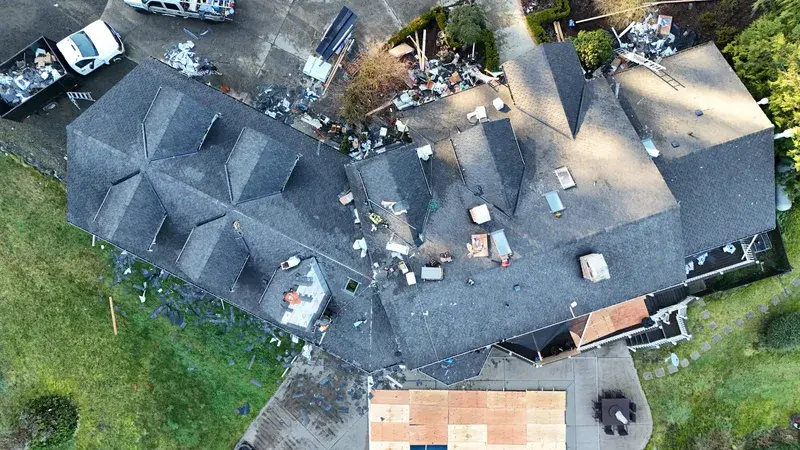
When the Johnson family in Bellevue noticed water stains spreading across their living room ceiling after a heavy rainstorm, they knew it was time to call in the professionals. Their 25-year-old asphalt shingle roof had served them well, but years of Pacific Northwest weather had taken their toll.
What started as a few ceiling stains quickly revealed a more complex picture: a roof that had aged past its functional lifespan, with multiple interconnected problems that no patch repair could solve. This is a story we encounter regularly in older Bellevue neighborhoods — homes built in the late 1990s and early 2000s are now reaching the natural end of their original roof's life. Their owners face a decision that is both significant and unavoidable.
The Challenge: What a 25-Year-Old Puget Sound Roof Looks Like
The original roof on the Johnson home had several issues that needed to be addressed:
- Multiple areas of moss damage and moisture retention — thick moss colonies had worked their way under shingles along the entire north-facing slope, lifting shingle tabs and allowing water infiltration across a wide area
- Worn and curling shingles throughout — granule loss had accelerated UV degradation, and shingle edges were visibly curling, breaking the watertight seal between courses
- Compromised flashing around the chimney — the original step flashing had corroded and separated, creating a direct water pathway into the attic every time it rained
- Inadequate attic ventilation — the ventilation system was undersized for the home's footprint, causing heat and moisture buildup that was degrading the roof decking from below
None of these problems were unusual. After 25 years in the Pacific Northwest climate — with its persistent seasonal rain, occasional freeze-thaw cycles, and heavy shade from neighboring Douglas firs — this is exactly what roofs look like at end-of-life. The only question is whether you address the problems proactively or wait until a ceiling collapses or visible mold appears in the attic.
Understanding Bellevue's Roofing Permit Requirements
Before any work began, we handled the permitting process — as we do on every project. In Bellevue, the City's roofing permit requirements distinguish between roof recovery (adding new material over existing) and full roof replacement (complete tear-off and reinstallation).
For a complete tear-off replacement like the Johnson project, homeowners and contractors need to know:
- A building permit is required when decking (substrate) repairs exceed five 4-by-8-foot sheets on a residential building
- When roof cavities are exposed during replacement, current energy code mandates that insulation be added or verified to meet minimum R-value requirements
- Any vented roof assembly must maintain a continuous air gap between the insulation and sheathing (per IRC Section R806.3) to preserve proper ventilation
King County's permit guidelines cover unincorporated areas of the county, while Bellevue and other incorporated cities maintain their own permit offices. Permit fees for residential roofing typically range from $146–$245.
Homeowners should always confirm permit requirements before starting any roofing project. An unpermitted roof replacement can create complications when selling a home, may void manufacturer warranties, and could expose you to liability if something goes wrong. The Seattle Roofing Company handles all permit research and applications as part of our project process — you never need to navigate city hall on your own.
What It Costs to Replace a Roof in Bellevue
Bellevue sits in one of the highest-cost construction markets in Washington State, and roof replacement costs reflect the regional labor market alongside the quality of materials required to withstand Pacific Northwest conditions.
For a typical Bellevue residential roof replacement in 2025–2026, homeowners can expect:
- Average project range: $14,000–$28,000 for standard-sized single-family homes using architectural shingles
- Architectural shingles installed: approximately $1.75–$5.50 per square foot, depending on the shingle product line and roof complexity
- Premium product lines (impact-resistant, algae-resistant, or extended-warranty shingles): at the higher end of the range
- Permit fees: typically $146–$245 for residential roofing permits in King County
The Johnson project fell within this range. It was a meaningful investment — but it needs to be weighed against the alternative. A roof that fails and allows sustained water intrusion into a home's structure can result in repair costs that far exceed the price of timely replacement: damaged drywall, soaked and moldy insulation, compromised roof framing, and in severe cases structural repairs that require engineering review. The National Roofing Contractors Association (NRCA) consistently points out that proactive roof maintenance and replacement is one of the most cost-effective home investments available to homeowners.
Our Solution: Full Tear-Off and Architectural Shingle Replacement
After a thorough inspection, we recommended a complete tear-off and replacement using architectural (dimensional) shingles. This was clearly the right approach for the Johnson home for several reasons.
Why architectural shingles over standard 3-tab? Architectural shingles are significantly heavier and more durable than standard 3-tab shingles. They carry better wind resistance ratings — typically 130 mph or higher — along with longer manufacturer warranties and a dimensional, layered appearance that adds real curb appeal. For a Bellevue home at this price point, the modest additional cost over 3-tab made clear financial sense, especially given the 30-year warranty coverage.
The Complete Project Scope
- Complete removal of old roofing materials — full tear-off down to the decking, with all debris removed from the property each day
- Inspection and repair of underlying decking — we found and replaced several sections of OSB sheathing where persistent moisture had caused softening and delamination
- Installation of new ice and water shield in valleys — this self-adhering membrane provides critical secondary protection in the areas most prone to water infiltration during freeze-thaw events and wind-driven rain
- Upgraded ridge ventilation system — we replaced the outdated and undersized box vents with a continuous ridge vent running the full length of the peak, dramatically improving attic airflow year-round
- Premium architectural shingles with 30-year manufacturer warranty — selected for their durability, built-in algae resistance, and color match to the neighborhood
- New flashing and drip edge throughout — all chimney step flashing, pipe boot flashing, and drip edge was replaced with new corrosion-resistant materials; reusing old flashing on a new roof is a false economy we never practice
The Ventilation Upgrade: Overlooked but Critical
The ventilation upgrade on this project deserves special attention, because inadequate attic ventilation is one of the most common — and most silently damaging — problems we find in older Pacific Northwest homes.
When an attic doesn't breathe properly, three cascading problems develop:
- Summer heat buildup bakes the shingles from below, degrading the asphalt and dramatically shortening roof life — often by five years or more
- Winter moisture accumulation condenses on cold sheathing, causing delamination, mold growth, and eventually structural rot
- Ice dam formation at the eaves during cold snaps forces water under the lower shingle courses, bypassing the underlayment and entering the home
The Johnson home's original ventilation system used undersized box vents that were marginal even when the roof was new. Over 25 years, as insulation was added and the home became tighter, those vents became progressively less adequate.
The continuous ridge vent system we installed works in tandem with the existing soffit intake vents to create a natural, passive airflow loop: cool outside air enters at the eaves, rises through the attic driven by the stack effect, and exits at the ridge. This system runs silently and continuously without any mechanical components or maintenance requirements.
The City of Bellevue's energy code requirements specifically mandate that vented roof assemblies maintain a gap between insulation and sheathing to preserve this airflow — a standard we always meet and verify before signing off on any project.
Timeline and Day-by-Day Breakdown
The project was completed in just 3 days, minimizing disruption to the Johnson family. Here's how the work unfolded:
Day 1: Complete tear-off of all old roofing materials. Decking inspection, with compromised sheathing sections marked and replaced. Ice-and-water shield installed in all valleys, around the chimney, and at the eaves. Site cleanup at end of day — no debris left exposed overnight.
Day 2: Full synthetic felt underlayment installed over the entire deck. Starter course and drip edge set at eaves and rakes. Architectural shingles installed from the starter course upward, with all flashing — step flashing at chimney, pipe boot covers, wall flashing — set in sequence as each section was completed.
Day 3: Ridge cap shingles installed along all hips and ridges. Continuous ridge vent system cut in and sealed. Final detail work on all penetrations and edges. Thorough cleanup including a full magnetic sweep of the lawn, driveway, and landscaping for stray fasteners.
A 3-day timeline is typical for a project at this scope and complexity, weather permitting. We maintain active communication with homeowners throughout — if weather changes force a pause, we contact the homeowner immediately and secure all exposed work with tarps until we can return.
The Results
The new roof not only solved the Johnson family's leak problem entirely — it transformed the appearance of the home. Curb appeal in Bellevue's competitive real estate market carries real value: a quality roofing system is one of the most prominent exterior features of any home, and one of the first things prospective buyers notice. A new roof can meaningfully improve a home's perceived value at sale.
Beyond aesthetics, the practical outcomes after installation:
- Zero leaks since installation — the comprehensive flashing work and full ice-and-water shield coverage eliminated every water entry point that had been plaguing the home
- Measurably cooler attic temperatures in summer — the ridge ventilation upgrade made a noticeable difference in both attic comfort and energy efficiency
- 30-year manufacturer warranty on the shingles, backed by our workmanship warranty covering installation quality
- Complete peace of mind that the home is protected through the next several decades of Pacific Northwest weather cycles
As the Johnsons put it: "We should have done this two years ago. We kept patching and it was never really solved. The new roof is a completely different experience."
Signs Your Bellevue Home May Need a Roof Replacement
If your home has a roof approaching 20 years of age or older, watch for these indicators that a replacement may be approaching:
- Granule loss collecting in gutters — asphalt granules washing off shingles is a clear sign of accelerated aging
- Visible daylight in the attic — any daylight visible through the roof deck means there's a gap that water can also use
- Soft or spongy spots when walking on the roof — a sign of compromised decking underneath
- Moss or algae growth, especially on north-facing slopes or areas with heavy tree shade
- A pattern of recurring repairs — a roof that needs patching every year or two may be telling you it's ready for replacement
For any roofing project, always confirm your contractor's license through Washington State Labor & Industries before signing any contract.
Frequently Asked Questions About Roof Replacement in Bellevue
Do I need a permit for a roof replacement in Bellevue? It depends on the scope of work. For a complete tear-off replacement, a permit is typically required if decking repair exceeds five 4-by-8-foot sheets. The City of Bellevue's permit guidelines explain the thresholds in full. We assess permit requirements on every project and handle the application process at no additional charge.
How long does a roof replacement take in Bellevue? Most residential replacements take 1–3 days. A home like the Johnson project — approximately 2,000 square feet of roof area with moderate complexity — completed in 3 full working days. Larger homes, steep pitches, or multiple roof levels take longer. We provide a realistic timeline with every written estimate.
How much should I budget for a roof replacement in Bellevue? In the current 2025–2026 market, expect $14,000–$28,000 for a typical Bellevue single-family home using architectural shingles. The range reflects differences in roof size, pitch, complexity, material choice, and the amount of decking repair required. We provide itemized written estimates so you understand exactly what you're paying for before any work begins.
What is the difference between architectural and 3-tab shingles? Architectural (dimensional) shingles are thicker, heavier, and more durable than 3-tab shingles. They carry longer manufacturer warranties (typically 30 years vs. 20–25 years), have better wind resistance ratings, and provide a more attractive layered appearance. The cost premium over 3-tab is modest, and the performance difference is significant over time. We recommend architectural shingles for virtually all residential projects in the Puget Sound region.
Can I replace just part of my roof rather than the whole thing? Sometimes, yes — if damage is genuinely isolated and the rest of the roof retains significant remaining life. Our inspection process helps determine whether a targeted repair or full replacement is the right call. We will never recommend a full replacement when a well-executed repair will do the job properly.
Will my homeowner's insurance cover the replacement? Homeowner's insurance typically covers roof damage caused by sudden events — storms, hail, falling trees — but not wear from normal aging. If your roof damage resulted from a qualifying weather event, we can work alongside your insurance claims process and provide documentation, measurements, and photos to support your claim. Contact us to discuss your specific situation and timeline.
Ready to transform your roof? [Contact us today](/contact) for a free, no-obligation estimate on your roof replacement project — or call us directly at (425) 675-3276. We serve Bellevue, Seattle, Kirkland, Redmond, Renton, and communities throughout the greater Puget Sound region.
Rory Knight
Rory Knight is the owner of The Seattle Roofing Company, a licensed roofing contractor serving the Greater Seattle area.
Licensed & bonded — verify us at lni.wa.gov: SEATTSR761Q5