Quick Answer: Architectural asphalt shingles are the right choice for most Seattle homes — they balance cost, durability, wind resistance, and algae protection better than 3-tab or luxury alternatives at the same price tier. Expect to pay $5.50–$7.00 per square foot installed, or $11,000–$18,000 for a typical Seattle home. For moss-prone or heavily shaded lots, choose products with copper or zinc algae-resistant granules. For storm resilience, prioritize Class 4 impact-rated options. This guide covers everything you need to know.
Asphalt shingles dominate Seattle rooftops for good reason. Walk through any neighborhood in Ballard, Bellevue, West Seattle, or Puyallup and the vast majority of homes you see are covered in asphalt. According to the Asphalt Roofing Manufacturers Association (ARMA), asphalt shingles account for approximately 75% of all residential roofing installed in North America — and in the Pacific Northwest, their combination of affordability, wind resistance, and design versatility makes them an especially practical fit.
But not all asphalt shingles perform the same in Seattle's climate. The persistent rain, biological growth pressure from moss and algae, high-wind events off Puget Sound, and occasional hail all demand more than a basic commodity shingle can deliver. Choosing the wrong product for your specific Seattle roof — the wrong algae-resistance rating, the wrong wind certification, or the wrong warranty tier — can mean premature failure, a moss-covered mess, or voided manufacturer coverage when you need it most.
This guide breaks down everything Seattle homeowners need to know about asphalt shingle roofing in 2026: the three main types and when each makes sense, which products perform best in Pacific Northwest conditions, real installed cost data, lifespan expectations, Energy Star options, the installation process, and how warranties actually work. Whether you're planning a full roof replacement or researching your next purchase years in advance, this is the information that matters for your specific market.
What Are Asphalt Shingles? A Quick Foundation
Asphalt shingles are manufactured from a fiberglass mat core saturated with asphalt, coated with mineral granules on the exposed weather surface, and backed with a release film to prevent sticking during storage. The granules provide UV protection, fire resistance, and — in the case of algae-resistant versions — copper or zinc compounds that inhibit biological growth.
The construction is well-suited to wet climates. Unlike wood shakes, asphalt shingles do not absorb moisture, rot, or split. Unlike metal, they do not require specialized seaming or expansion control. They're flexible enough to accommodate the thermal cycling Seattle experiences across seasons, and they're manufactured to tight dimensional tolerances that support the consistent overlapping pattern required for watertight performance.
The National Roofing Contractors Association (NRCA) classifies asphalt shingles into three primary categories based on construction and profile — and understanding those categories is the first step to choosing the right product for your Seattle home.
The Three Types of Asphalt Shingles
3-Tab Shingles
The original asphalt shingle design, 3-tab shingles are a single flat layer with three cut-out tabs that simulate the look of individual slate tiles. They're lighter than architectural shingles (roughly 200–250 lbs per square vs. 280–400 lbs), thinner, and less expensive to manufacture — which shows up directly in material and installed cost.
The problem in Seattle: 3-tab shingles are largely obsolete for a reason. Their wind resistance ratings typically cap at 60–70 mph under standard testing, which is inadequate for Puget Sound windstorm exposure. Their single-layer construction provides less dimensional rigidity, making them more prone to blow-offs, cracking under repeated thermal cycling, and granule loss over time. Most leading manufacturers — including GAF and CertainTeed — have significantly narrowed their 3-tab product lines in favor of architectural shingles. If a contractor bids 3-tab on your Seattle home, consider it a red flag.
Where they still make sense: Budget-constrained rental properties, outbuildings, or structures where longevity is less critical. Even then, we rarely recommend them in the Seattle market.
Architectural (Dimensional) Shingles
Architectural shingles — also called dimensional or laminated shingles — use two or more layers of asphalt laminated together to create a three-dimensional, wood shake-like appearance and substantially better structural performance. They are the industry standard for residential roofing in the Pacific Northwest and the product we install on the vast majority of Seattle-area homes.
The performance improvements over 3-tab are significant:
- Wind resistance ratings up to 130 mph (versus 60–70 mph for 3-tab)
- Greater resistance to impact from hail and tree debris
- Better granule retention and longer service life
- Available in algae-resistant versions critical for Seattle's biological growth environment
- Wider design range — dozens of profiles, textures, and color options to complement any architectural style
Leading architectural shingle products for Seattle include GAF Timberline HDZ, IKO Cambridge Xtreme 42°, and CertainTeed Landmark Pro. Each offers certified 130 mph wind ratings, algae-resistant granule options, and manufacturer warranty programs that provide meaningful coverage when properly installed by a certified contractor. If you're weighing brands, our detailed GAF vs. IKO shingle comparison for Seattle roofs covers the differences in depth.
Luxury / Designer Shingles
Luxury or designer shingles represent the premium tier of asphalt shingle roofing. They use the thickest laminate construction, the heaviest granule application, and the most dimensional profiles — replicating the look of natural slate or hand-split wood shake with significantly lower cost and weight than the real materials.
Examples include GAF Grand Sequoia, IKO Armourshake, and CertainTeed Grand Manor. They carry enhanced wind warranties (often up to 150 mph), longer algae-resistance guarantees, and higher Class 4 impact ratings on many SKUs. The tradeoff is cost: luxury shingles run $1.50–$3.00 per square foot more than standard architectural shingles at the material level, adding up to a meaningful increase on a full Seattle-area roof.
When to consider luxury shingles: Historically significant homes in neighborhoods like Capitol Hill or Queen Anne where slate or shake aesthetics are architecturally appropriate, high-value properties where curb appeal materially affects resale value, or any situation where Class 4 impact resistance is a priority without moving to a different roofing material entirely.
Asphalt Shingle Types at a Glance
| Shingle Type | Installed Cost (Seattle) | Wind Rating | Lifespan (Seattle) | Algae-Resistant Options | Best For |
|---|
| 3-Tab | $4.50–$5.50/sqft | 60–70 mph | 12–18 years | Limited | Outbuildings, budget rentals |
| Architectural | $5.50–$7.00/sqft | 130 mph | 20–25 years | Yes — broad selection | Most Seattle homes |
| Luxury/Designer | $7.00–$10.00/sqft | 130–150 mph | 25–30 years | Yes — enhanced | High-value homes, slate aesthetics |
Why Asphalt Shingles Perform Well in Seattle's Climate
Seattle's climate presents a specific set of roofing challenges: approximately 150+ rainy days per year, sustained high-humidity periods that promote biological growth, seasonal high-wind events from Puget Sound and the Cascades, occasional freeze-thaw cycling at higher elevations, and persistent moss and algae pressure on north-facing and shaded surfaces.
Modern architectural asphalt shingles are engineered to handle this environment better than any other common roofing material at their price point. Their granule surface sheds water effectively without requiring the seam welding of single-ply membranes. Their fiberglass mat core resists moisture absorption. Their manufactured dimensional weight provides meaningful resistance to wind uplift — the primary failure mode during Puget Sound windstorms.
Compared to wood shake, asphalt eliminates the rot and splitting risk that Seattle's moisture creates. Compared to metal, it dramatically reduces material and installation cost while still delivering 20–25 year service life. Compared to tile, it's far lighter (relevant for older Seattle home framing) and far less expensive. If you're curious how the full material comparison works out in Seattle conditions, our guide to asphalt vs. metal roofing in Seattle walks through the long-term economics of each option.
Best Asphalt Shingles for Seattle Rain and Wind
Wind Resistance: What the Ratings Mean
Wind resistance ratings for asphalt shingles are governed by standardized test protocols from Underwriters Laboratories (UL) and the American Society for Testing and Materials (ASTM). The two primary standards are:
- UL 2390 — the newer standard using real-size shingle specimens; it's more conservative than older tests and increasingly required for certified wind warranties
- ASTM D3161 (Class F) — older standard rating shingles to 110 mph
For Seattle, look specifically for shingles certified to 130 mph under UL 2390. This rating, combined with proper installation nailing patterns (6 nails per shingle for high-wind exposure), represents the appropriate performance threshold for the Pacific Northwest's recorded windstorm events. Major products at this rating include GAF Timberline HDZ (rated 130 mph UL 2390), IKO Cambridge Xtreme 42° (130 mph), and CertainTeed Landmark Pro (130 mph).
Note that the wind warranty on these products often requires a specific underlayment, starter strip product, and minimum shingle overlap — which is exactly why choosing a certified installer who installs the full manufacturer system matters for warranty validity. The Washington State Department of Labor & Industries (L&I) licenses roofing contractors in Washington State; confirming your contractor's L&I license is the first verification step.
Class 4 Impact Resistance for Pacific Northwest Hail
Seattle homeowners are sometimes surprised to learn that the region experiences hail. While western Washington sees far less hail than the Midwest or Great Plains, hail events do occur — particularly during late spring convective storms — and the Pacific Northwest's abundant tree canopy means shingles absorb ongoing impact from branches, pine cones, and debris during wind events.
Impact resistance for asphalt shingles is classified by the Insurance Institute for Business & Home Safety (IBHS) and UL using the UL 2218 steel ball drop test, with four classes:
- Class 1: 1.25" ball drop
- Class 2: 1.5" ball drop
- Class 3: 1.75" ball drop
- Class 4: 2" ball drop — the highest rating, requiring no cracking on any sample
Class 4 shingles are the most durable asphalt option available. Products earning this rating include IKO Nordic, GAF ArmorShield II, and CertainTeed Presidential Shake among luxury options. Beyond physical resilience, Class 4 designation matters for Seattle homeowners because many Washington State insurance carriers offer premium discounts for Class 4 roofing — reducing your annual premium enough to partially offset the higher installed cost over the roof's life.
Algae-Resistant and Moss-Resistant Shingles for Seattle
Algae and moss are not cosmetic nuisances in Seattle — they're active roof degradation agents. Black algae streaks (caused by Gloeocapsa magma bacteria) consume the limestone filler in granules, accelerating granule loss and reducing shingle lifespan. Moss growth lifts shingle edges and creates channels for water intrusion under the shingle plane, leading to deck rot and interior leaks over time.
Seattle's combination of shade (from Douglas firs, western red cedars, and neighboring structures), high annual rainfall, and mild temperatures creates year-round conditions favorable to biological growth. A roof installed without moss mitigation on a shaded north-facing lot can show visible moss within 3–5 years in our market.
What "Algae-Resistant" Actually Means
Algae-resistant shingles use granules infused with copper or zinc compounds that slowly leach out under rainfall, creating a surface environment inhospitable to algae. The technology works — but the warranty duration varies considerably between products and manufacturers:
- GAF StainGuard Plus: 25-year algae-resistance limited warranty on qualifying products. The longer warranty on the market from a major manufacturer.
- CertainTeed StreakFighter: 15-year algae warranty on standard Landmark; extended on Landmark Premium and Grand Manor.
- IKO Armourzone/ArmourZone Plus: 15-year algae warranty on Cambridge Xtreme; longer on Dynasty and Nordic lines.
For Seattle homes, particularly those with significant shade from mature trees, we prioritize algae-resistance warranty length in our recommendations. The 25-year StainGuard Plus coverage is a meaningful differentiator in our climate. You can read more about preventing and treating moss growth on Seattle roofs in our guide to moss on roofs in Seattle.
Energy Star Asphalt Shingles for Seattle Homes
Energy Star certified roofing products use highly reflective granules to reduce heat absorption through the roof assembly, lowering attic temperatures and reducing cooling loads. For most Seattle homes, the direct energy savings from cool roofing are modest — Seattle's mild summers mean air conditioning loads are lower than in hotter climates — but the benefits extend beyond energy savings.
Reflective asphalt shingles run cooler in summer, which reduces thermal cycling stress on the shingle itself and can modestly extend service life. They may also qualify for utility rebates from Puget Sound Energy or Seattle City Light, though availability changes annually — check directly with your utility before factoring rebates into your budget. For homes with solar panels, lighter-colored Energy Star shingles can also improve panel efficiency by reducing panel temperature through conductive heating from the roof surface.
Popular Energy Star-qualified asphalt shingles for Seattle include GAF Timberline Cool Series and CertainTeed Landmark Solaris. These are not dramatically more expensive than standard architectural shingles — typically $0.25–$0.75 per square foot more — and they qualify for the same wind and algae-resistance ratings as their non-cool counterparts.
How Long Do Asphalt Shingles Last in Seattle?
Asphalt shingle lifespan in Seattle is a frequently misunderstood topic. National averages cited by manufacturers — 25 to 30 years for architectural shingles, lifetime for luxury lines — reflect performance in ideal conditions. Seattle's climate imposes specific stresses that reduce practical lifespan compared to those benchmarks.
The primary factors shortening shingle life in the Pacific Northwest:
Biological growth: Moss and algae accelerate granule loss and lift shingle edges. Without periodic treatment or algae-resistant granules, this is the single largest threat to shingle longevity in Seattle.
Persistent moisture: Extended wet periods keep the shingle surface saturated, which accelerates aging compared to climates with regular drying periods.
Attic ventilation: Seattle homes — particularly older bungalows in neighborhoods like Wallingford, Fremont, and the Central District — often have inadequate attic ventilation. Trapped heat in summer and moisture in winter accelerate shingle aging from the underside. A properly ventilated attic is the most impactful variable a homeowner controls.
Realistic Seattle expectations by shingle type:
| Shingle Type | Manufacturer Claim | Realistic Seattle Lifespan | With Maintenance & Algae Control |
|---|
| 3-Tab | 25 years | 12–18 years | 16–20 years |
| Architectural | 30–Lifetime | 20–25 years | 22–27 years |
| Luxury/Designer | Lifetime | 25–32 years | 28–35 years |
For a complete breakdown of roofing lifespan factors specific to Seattle's climate, see our guide on how long a roof lasts in Seattle.
Cost of Asphalt Shingle Roofing in Seattle (2026)
Installed cost for asphalt shingle roofing in Seattle runs higher than national averages for several reasons: labor rates in King, Snohomish, and Pierce counties are among the highest in the country for skilled trades, rain-related scheduling overhead builds in real cost, and Seattle homes — particularly in established neighborhoods — often have complex rooflines with multiple valleys, dormers, and penetrations that increase labor hours relative to square footage.
Installed Cost by Shingle Type (2026 Seattle Market)
| Shingle Category | Material Cost (per square) | Installed Cost (per sqft) | Typical Seattle Home Total |
|---|
| 3-Tab (basic) | $90–$120 | $4.50–$5.50 | $8,000–$12,000 |
| Architectural (standard) | $120–$160 | $5.50–$7.00 | $11,000–$16,000 |
| Architectural (premium / algae-resistant) | $150–$200 | $6.00–$7.50 | $13,000–$18,000 |
| Luxury / Designer | $200–$320 | $7.00–$10.00 | $16,000–$26,000 |
Assumes full tear-off of existing roof, replacement of damaged decking if needed, new underlayment, ice-and-water shield at eaves and valleys, new drip edge, and basic flashing replacement. Prices reflect average King County rates as of mid-2026.
What Moves the Price Up or Down
Pitch: A steep 9/12 or 12/12 pitch roof requires safety equipment, slower working pace, and more labor hours per square. Expect a 20–35% premium over a low-slope equivalent.
Decking condition: If the plywood or OSB roof deck has rot — common in Seattle homes that have had persistent leaks — deck replacement adds $2–$5 per square foot of affected area.
Complexity: Valleys, dormers, skylights, chimneys, and pipe penetrations each add flashing labor. A simple gable roof costs less per square than a complex hip roof with multiple penetrations.
Permit requirements: The City of Seattle's Department of Construction and Inspections (SDCI) requires permits for some roof replacements, particularly for multi-family structures and projects involving structural sheathing replacement. Permit costs typically run $200–$600 and should be included in contractor bids.
For a detailed cost breakdown with real numbers for Seattle's sub-markets, see our complete roof replacement cost guide for Seattle.
The Asphalt Shingle Installation Process in Seattle
Understanding the installation process helps you evaluate contractor quality, ask the right questions during bidding, and recognize shortcuts that will cost you later. A correctly installed asphalt shingle roof in Seattle includes the following sequence:
Step 1: Tear-Off and Deck Inspection
All existing roofing materials are removed to the bare roof deck. This full tear-off — never overlaying new shingles on top of old ones, which we never recommend — exposes the plywood or OSB deck for inspection. Any soft spots, rot, delamination, or improper fastening patterns are identified and repaired before anything else proceeds. Skipping this step or layering shingles is a structural risk and voids most manufacturer warranties.
Step 2: Ice-and-Water Shield
In Seattle, ice-and-water shield is not optional — it's a mandatory part of a correct installation. This self-adhering waterproof membrane is installed at all eaves (minimum 24 inches past the inside of the exterior wall), in all valleys, around all penetrations, and at other vulnerable transition points. Seattle's driving rain events create hydrostatic pressure conditions where normal underlayment alone is insufficient. For more on why this matters specifically in Pacific Northwest conditions, see our article on ice-and-water shield in Seattle.
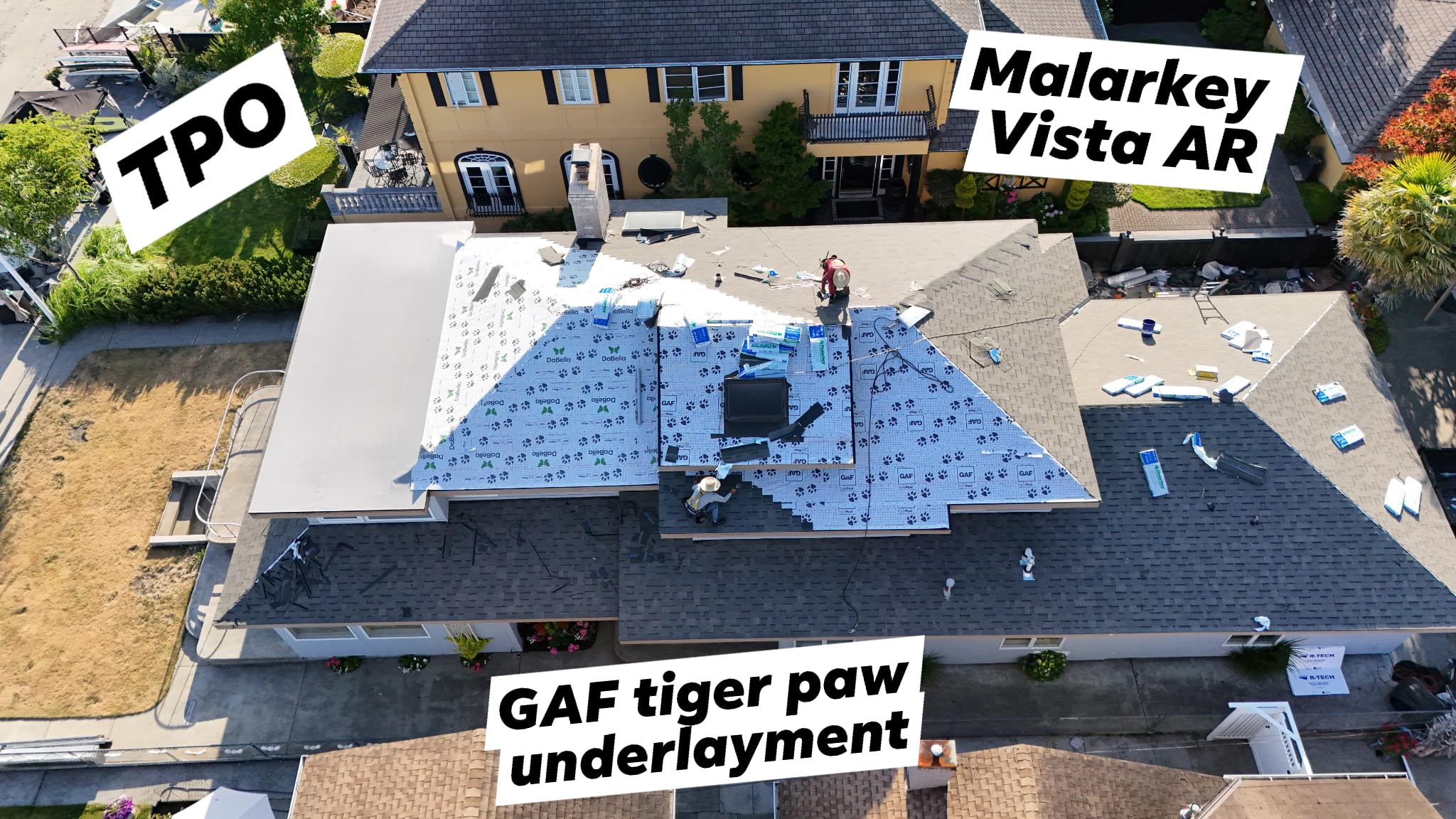
Step 3: Synthetic Underlayment
After ice-and-water shield is applied at vulnerable zones, synthetic underlayment (15 lb felt is no longer the standard for Seattle conditions) is installed across the remaining deck area. Modern synthetic underlayments offer superior tear resistance, water resistance, and UV stability compared to traditional felt. They are also significantly lighter and easier to work with safely on wet Seattle roofs.
Step 4: Drip Edge and Starter Strips
Drip edge — a metal flashing at eaves and rakes — directs water away from the fascia and into the gutter. Starter strips at the eave provide the sealant strip that bonds the first course of shingles, preventing wind uplift at the most exposed edge of the roof.
Step 5: Shingle Installation
Shingles are installed from the eave upward, with each course offset to prevent seams from aligning vertically. Nailing patterns follow manufacturer specifications — typically 6 nails per shingle in high-wind areas — using roofing nails at the correct gauge and penetration depth. Over-driven nails cut through the mat; under-driven nails fail to engage the deck properly. Both are installation defects that reduce wind resistance and can void warranties.
Step 6: Flashing Replacement
All step flashing at wall intersections, counter flashing at chimneys, pipe boot flashing at penetrations, and valley metal are replaced or installed new. Flashing failure is the number one cause of Seattle roof leaks — never allow a contractor to reuse old flashing as a cost-saving measure on a new shingle installation.
Step 7: Ridge Cap and Ventilation Verification
Hip and ridge cap shingles complete the installation. Before work begins, a reputable Seattle roofer should assess attic ventilation balance — intake at soffit and exhaust at ridge — and upgrade it if deficient. Inadequate ventilation is a roof-killer in Seattle's climate. Schedule a professional roof inspection if you're unsure of your current ventilation status.
Understanding Asphalt Shingle Warranties
Warranty coverage for asphalt shingles operates at two distinct levels, and understanding the difference prevents disappointment when claims are filed.
Manufacturer (Material) Warranty
This covers defects in the shingle material itself — delamination, cracking from manufacturing defects, algae coverage failure within the rated period. Most architectural shingles carry "Lifetime" limited material warranties, but this designation requires scrutiny. "Lifetime" in warranty language typically means the lifetime of the original owner's ownership of the structure, not 50 years of absolute coverage. Prorated terms that reduce coverage after Year 10 are common on standard warranties.
Enhanced warranty programs — GAF System Plus and GAF Golden Pledge, CertainTeed SureStart PLUS and 5-Star Warranty, and IKO ROOFPRO Enhanced — provide non-prorated coverage for extended terms (typically 50 years non-prorated), stronger algae-resistance coverage, and in some cases extended wind resistance warranties up to 130 mph. These enhanced warranties require installation by a manufacturer-certified contractor using the full manufacturer roofing system (specific underlayment, starter, and ridge cap products from the same manufacturer).
Workmanship Warranty
This covers installation errors — flashing failures, improper fastening, inadequate underlayment — for a defined period after installation. Workmanship warranties are provided by the installing contractor, not the manufacturer, and they vary enormously in the market: from 1 year on low-end bids to 10–25 years from certified contractors enrolled in enhanced manufacturer programs.
GAF's Golden Pledge warranty — only available through GAF Master Elite certified contractors — covers both materials and workmanship for 25 years on a non-prorated basis. This is the strongest asphalt shingle warranty combination available in the market. When evaluating contractor bids, the warranty tier being offered is a direct indicator of contractor quality and manufacturer relationship.
How to Choose the Right Asphalt Shingle for Your Seattle Home
With the full picture in view, here's a practical decision framework for Seattle homeowners:
For most Seattle homes: Choose an architectural shingle with 130 mph wind certification, a 15–25 year algae-resistance warranty, and a non-prorated enhanced warranty through a certified contractor. GAF Timberline HDZ or CertainTeed Landmark Pro represent the best value at this tier.
For heavily shaded lots (north-facing, under mature Douglas firs or cedars): Prioritize the longest algae-resistance warranty available — GAF's StainGuard Plus at 25 years — and plan for annual spring inspections to monitor moss emergence before it establishes.
For storm-exposed locations (waterfront homes, hilltop exposure in West Seattle, Magnolia, or the Eastside hills): Upgrade to a Class 4 impact-resistant architectural shingle. IKO Nordic and GAF ArmorShield II are the leading options at this performance tier.
For high-value homes or historically sensitive neighborhoods: Luxury dimensional shingles that replicate natural slate or shake aesthetics provide the performance of Class 4-rated architectural shingles with elevated curb appeal. The installed cost premium is typically $3,000–$7,000 over standard architectural shingles on a typical Seattle home.
Before any material decision: Have your attic ventilation assessed. The best shingle on the market will underperform its rated lifespan on a roof with blocked soffit vents or inadequate ridge exhaust. This is the most overlooked variable in Seattle roof longevity, and it costs nothing to verify during an initial inspection.
Ready to Get a Quote on Asphalt Shingles for Your Seattle Home?
The Seattle Roofing Company is a GAF Master Elite and IKO ROOFPRO Premium certified contractor serving all of King, Snohomish, and Pierce counties. We install the full range of asphalt shingle products — 3-tab, architectural, and luxury — with the manufacturer certification required to offer enhanced material and workmanship warranties on qualifying installations.
Every quote starts with a thorough roof inspection, including attic ventilation assessment, deck condition evaluation, and a photo report you keep regardless of whether you hire us. We'll recommend the specific shingle product and warranty tier that matches your home's exposure, your budget, and your intended tenure in the property — not the highest-margin option in our inventory.
Contact us to schedule your free roof inspection and estimate — we typically schedule within 3–5 business days for non-emergency assessments, with same-day availability for active leaks or storm damage.


 Roofing Tips
