Quick Answer: Metal roofing is one of the best long-term investments a Seattle homeowner can make. With a lifespan of 40–70 years, near-immunity to moss, and superior water-shedding performance in our rainy climate, metal outperforms asphalt shingles on virtually every durability metric. The trade-off is upfront cost: installed prices for Seattle metal roofing run $14–$25 per square foot depending on system type, versus $7–$12/sq ft for architectural asphalt. If you plan to stay in your home 15+ years, the lifetime cost math typically favors metal — and Seattle's specific climate conditions make that case stronger than almost anywhere in the country.
Seattle homeowners are replacing asphalt shingle roofs with metal at an accelerating pace, and the drivers are straightforward. The city averages over 37 inches of rain per year spread across more than 150 wet days. Add endemic moss pressure from the combination of persistent moisture, shaded canopy, and mild temperatures, and you have a climate where a roof's long-term waterproofing integrity is tested every single year. The asphalt roofs installed throughout the 1990s and early 2000s during Seattle's housing expansion are now hitting or passing their replacement windows, and many homeowners doing that calculation for the second time are asking a different question: instead of replacing asphalt with asphalt, what happens if we go metal?
This guide answers that question completely. We cover the three primary metal roofing systems available in Seattle, realistic 2026 cost data for the King County market, lifespan and performance expectations in Pacific Northwest conditions, energy efficiency benefits, Seattle permit requirements, the installation process, and what ongoing maintenance actually looks like for a metal roof in this climate. By the end, you'll have everything you need to decide whether metal is the right call for your specific home and situation.
Types of Metal Roofing Available in Seattle
Not all metal roofing is the same. The three systems used most commonly in Seattle residential projects — standing seam, metal shingles, and corrugated metal panels — differ significantly in cost, waterproofing method, aesthetic, and long-term performance. Understanding the differences is the foundation of any informed metal roofing decision.
Standing Seam Metal Roofing
Standing seam is the premium standard in residential metal roofing and the system most often recommended for Seattle homes. The defining characteristic is its concealed fastener design: panels interlock through raised seams that run vertically down the roof slope, and the panels themselves are attached to the deck through hidden clips — not through the weather-facing metal surface. There are no exposed screws or nails on the field of a standing seam roof.
Why this matters for Seattle: Every exposed fastener in a roofing system is a potential future leak point. The screw penetrates the metal, and over decades, the rubber gasket degrades, the metal fatigues from repeated thermal expansion and contraction, and water eventually finds a path through. Standing seam eliminates this failure mode entirely. In a climate where rain falls 150+ days per year, the difference between a concealed-fastener system and an exposed-fastener one compounds significantly over a 50-year service life.
Standing seam panels are typically manufactured from Galvalume steel — a zinc-aluminum-silicon alloy coating over cold-rolled steel — or aluminum. For Seattle's marine-influenced climate, aluminum deserves particular attention: it's naturally corrosion-resistant without requiring a surface coating, won't rust if the surface is scratched, and performs exceptionally well in environments with elevated atmospheric moisture. Galvalume steel is a cost-effective alternative with excellent corrosion resistance that meets the performance demands of most Pacific Northwest residential applications.
The hidden clip attachment system accomplishes a second important function: it allows the metal panel to expand and contract freely through temperature cycles without placing mechanical stress on the fastener. This thermal float is why standing seam systems have dramatically fewer fatigue failures than through-fastened alternatives over long service lives.
Installed cost in Seattle (2026): $18–$25 per square foot, including tear-off of existing material, synthetic underlayment, panel installation, flashings, ridge, and trim. A typical 2,000 sq ft Seattle home sees a standing seam project total of $36,000–$50,000.
Lifespan: 50–70 years for aluminum; 40–60 years for Galvalume steel with quality Kynar 500 or PVDF coating.
Best for: Homeowners planning long-term occupancy, contemporary or modern architectural styles, homes with a history of leak problems, and any situation where zero-maintenance fastener integrity is a priority.
Metal Shingles
Metal shingles offer the core performance benefits of metal roofing — longevity, moss resistance, fire rating, wind performance — in a profile that closely mimics the look of traditional asphalt shingles, cedar shakes, or slate tile. They're stamped from steel or aluminum and coated with baked-on Kynar or PVDF finish that provides decades of color stability and chalk resistance.
The fastening method uses screws driven through the top flange of each shingle, which is then covered by the overlapping course above — a step-lap design that provides significantly better weather resistance than fully exposed corrugated panels, though without the complete fastener concealment of standing seam. In practice, metal shingles perform very well in Seattle conditions when installed with quality underlayment and proper valley flashing.
The primary appeal in the Seattle residential market is aesthetic compatibility. In neighborhoods like Maple Leaf, Wedgwood, Ravenna, Bellevue's Lake Hills, or Kirkland's Rose Hill — where craftsman bungalows, traditional two-stories, and mid-century homes dominate — standing seam's industrial panel aesthetic can feel out of place. Metal shingles blend into established neighborhood character while delivering the moss resistance and longevity that distinguish metal from asphalt.
Installed cost in Seattle (2026): $14–$20 per square foot. A 2,000 sq ft roof typically runs $28,000–$40,000 installed.
Lifespan: 40–60 years for quality steel or aluminum products with factory-applied PVDF coating.
Best for: Homeowners who want metal performance within a traditional aesthetic, particularly in established residential neighborhoods where standing seam's contemporary profile would be architecturally incongruous.
Corrugated Metal Panels
Corrugated metal panels — the ripple-profiled sheets long associated with agricultural buildings — have gained a foothold in Seattle's residential market, driven by the rise of modern farmhouse and contemporary architectural styles. Modern corrugated metal for residential use is manufactured from Galvalume steel or aluminum with factory-applied painted finishes, and installed using exposed rubber-gasketed screws.
The exposed fastener design is the primary long-term performance consideration. Corrugated panels installed correctly — with quality EPDM closure strips at eaves and ridges, correct panel overlaps at joints, and 250 series rubber-gasketed fasteners — perform adequately in residential applications. However, the maintenance requirement that standing seam avoids is real: rubber gaskets on exposed fasteners degrade over 15–20 years in UV exposure and wet-dry cycling. Periodic re-fastening with new gasketed screws is a maintenance task that corrugated systems require and standing seam does not.
Installed cost in Seattle (2026): $10–$15 per square foot. A 2,000 sq ft roof typically runs $20,000–$30,000 installed.
Lifespan: 30–45 years with proper maintenance of fasteners and closures.
Best for: Agricultural buildings, outbuildings, covered decks, modern farmhouse aesthetics, lower-slope secondary structures, and projects where budget constrains standing seam but the homeowner still wants metal's core durability advantages over asphalt.
A Note on Other Metal Systems
Beyond the three primary systems, Seattle homeowners occasionally encounter stone-coated steel (panels with a concrete stone chip finish that mimics tile or shake — brands like Decra and Gerard), zinc roofing (a premium European material that develops a characteristic gray patina and self-heals minor surface scratches), and copper (the ultimate premium product with a 100+ year service life and a price point that reflects it). Each has legitimate applications. Stone-coated steel is particularly popular for homeowners who want metal performance with a heavyweight tile aesthetic at a lower cost than real tile. These materials represent a smaller share of Seattle residential metal roofing installations but are worth discussing with a specialist if their properties align with your goals.
Metal Roofing Cost in Seattle: 2026 Market Data
Seattle's roofing labor market runs above the national average. Licensed journeyman roofers in King, Pierce, and Snohomish Counties earn $65–$95 per hour, and specialty metal roofing work — particularly standing seam fabrication and installation — commands the upper range. The figures below reflect Seattle market conditions as of mid-2026.
| System | Material Cost/sq ft | Installed Cost/sq ft | 2,000 sq ft Total |
|---|
| Standing seam — Galvalume steel | $4–$7 | $18–$22 | $36,000–$44,000 |
| Standing seam — Aluminum | $6–$10 | $20–$25 | $40,000–$50,000 |
| Metal shingles — Steel | $3–$6 | $14–$18 | $28,000–$36,000 |
| Metal shingles — Aluminum | $5–$8 | $16–$20 | $32,000–$40,000 |
| Corrugated panels — Galvalume | $2–$4 | $10–$14 | $20,000–$28,000 |
| Stone-coated steel | $5–$9 | $16–$22 | $32,000–$44,000 |
What drives cost higher on Seattle projects:
- Roof complexity: Multiple hips, valleys, dormers, skylights, and chimney penetrations significantly add labor time and increase material waste. A complex craftsman bungalow roof with four dormers and a chimney costs 30–50% more per square foot than a simple gable.
- Steep pitch: Pitches above 6:12 require additional safety equipment and slow installation pace. Expect a 10–20% labor surcharge for steep roofs — common on the traditional two-story homes throughout Seattle's residential neighborhoods.
- Tear-off and disposal: Removing existing asphalt shingles, cedar shakes, or a previous metal system adds $1.50–$3.00 per square foot. King County transfer station tipping fees run $150–$200 per ton, and Seattle's roofing debris fees have increased with regional waste disposal costs.
- On-site panel fabrication: Quality standing seam contractors often bring portable roll-forming equipment and fabricate panels to exact length on-site. This eliminates end-lap joints (a waterproofing improvement) but adds a day of setup cost.
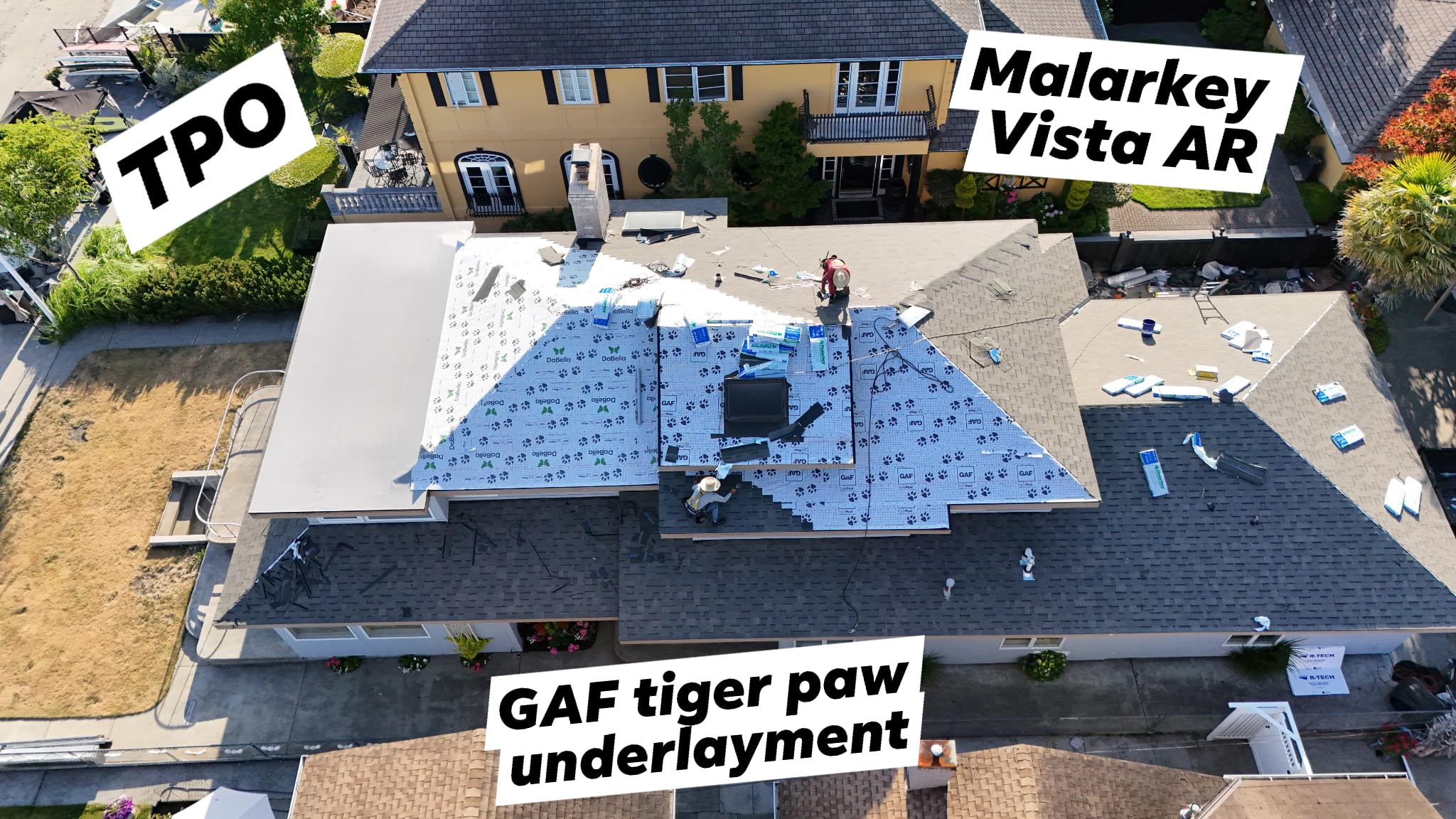
- Underlayment specification: Standing seam metal requires non-bituminous synthetic underlayment — not traditional felt, which off-gases volatile compounds that can corrode metal panels from below. Premium products like VersaShield, GAF's Tiger Paw, or Grace Ice & Water in valleys add $0.50–$1.50 per square foot.
- Deck condition: Seattle's older housing stock frequently has deteriorated decking beneath failing roofs. Replacing rotted or delaminated plywood, typically discovered during tear-off, adds cost that can only be estimated after removal.
For a detailed breakdown of how metal compares to asphalt across the full replacement cycle — including two replacement rounds of asphalt versus one metal installation over 50 years — see our guide on roof replacement cost in Seattle.
Metal Roofing vs. Asphalt Shingles: Seattle Comparison
The core question most Seattle homeowners face is whether metal's higher upfront cost is justified by its long-term performance advantages. Here's an honest side-by-side:
| Feature | Metal Roofing | Architectural Asphalt Shingles |
|---|
| Installed cost — 2,000 sq ft | $20,000–$50,000 | $12,000–$24,000 |
| Lifespan | 40–70 years | 20–30 years |
| Replacements over 50 years | 0–1 | 1–2 |
| Moss/algae resistance | Excellent — no organic foothold | Poor — requires annual treatment in Seattle |
| Water shedding | Superior — smooth surface, fast runoff | Good — granule texture slows flow |
| Wind resistance | 110–160 mph (system dependent) | 90–130 mph |
| Fire rating | Class A (most systems) | Class A (UL-listed products) |
| Energy efficiency | High — reflective coatings available | Moderate |
| Weight per square (100 sq ft) | 50–150 lbs | 200–350 lbs |
| Noise in heavy rain | Low with solid substrate | Low |
| 50-year total cost estimate | $25,000–$55,000 | $28,000–$60,000 |
| Home resale contribution | Strong — transferable warranty value | Moderate |
The 50-year total cost comparison is the most useful metric for the Seattle market. A standing seam roof installed today for $45,000 will likely outlast two full asphalt replacements — installed today at roughly $18,000 and again in 25 years at projected cost-inflation pricing of $25,000+. That doesn't account for the recurring moss treatment, shingle repair, and flashing work that asphalt requires in Seattle's wet climate and metal largely avoids.
For a thorough analysis of this comparison with Seattle-specific data, our dedicated article on asphalt vs. metal roofing in Seattle works through the full lifecycle cost calculation.
Lifespan: How Long Does Metal Roofing Last in Seattle?
The Metal Roofing Alliance reports that properly installed metal roofing lasts 40–70 years — two to three times the rated lifespan of standard architectural asphalt shingles. In Seattle's specific climate, that estimate holds well and actually improves for aluminum and properly coated Galvalume systems for several reasons.
Mild temperatures reduce thermal fatigue. Metal roofing degrades most rapidly under extreme thermal cycling — the mechanical stress of repeated large-scale expansion and contraction. Seattle's famously mild climate (averages of 38°F in January and 77°F in August) produces relatively modest thermal movement compared to Phoenix (where 110°F summer days create severe expansion stress) or Minneapolis (where -20°F winters generate significant contraction). A Seattle metal roof experiences less cumulative mechanical fatigue than the same system installed in a more extreme climate.
Continuous rainfall doesn't degrade metal. Unlike asphalt, which absorbs water and gradually breaks down its organic fiberglass or organic mat substrate, metal is impervious to moisture absorption. Seattle's rainfall quantity has essentially no degradation effect on steel or aluminum. What matters is the coating integrity (which determines corrosion resistance) and the seam and flashing system (which determines waterproofing) — both of which are installation quality and material grade factors, not climate-driven ones.
Marine environment consideration. Seattle's proximity to Puget Sound means elevated salt content in the air, particularly in waterfront-adjacent neighborhoods — West Seattle, Magnolia, Eastlake, Mercer Island, and communities near the water in Kirkland and Bellevue. In salt-air environments, bare or poorly coated steel corrodes faster than aluminum or high-quality Galvalume. If your home is within a mile or two of the shoreline, specify aluminum standing seam or confirm your contractor is using Galvalume with Kynar 500 or PVDF coating rather than a lower-grade polyester finish. This distinction matters over a 50-year service life.
For context on how metal compares to asphalt and cedar shake on total expected service life, see our guide on how long a roof lasts in Seattle.
Energy Efficiency: Metal Roofing and Seattle's Climate
Metal roofing delivers meaningful energy efficiency benefits, though the mechanism and magnitude in Seattle differ from sunnier, hotter climates.
Cool roof reflectance. Many metal roofing products qualify as "cool roofs" under ENERGY STAR's criteria for steep-slope roofing products, which requires an initial solar reflectance of ≥ 0.25 and a three-year aged reflectance of ≥ 0.15. Lighter-colored metal panels — white, light gray, stone, tan — can reflect 50–70% of incident solar radiation, reducing heat gain through the roof deck compared to dark asphalt shingles that absorb 85–90% of solar energy.
In Seattle's overcast climate, the reflectance benefit is less dramatic than in Phoenix or Los Angeles — you're reflecting sunlight that arrives at a lower angle and lower average intensity. However, the effect is real during Seattle's dry summers, when clear skies and temperatures in the upper 70s and 80s create genuine cooling loads that a reflective metal roof can meaningfully reduce.
Thermal emissivity. Beyond reflectance, metal's high thermal emissivity — its ability to radiate absorbed heat back into the atmosphere rather than retaining it — matters throughout the cooling season. Light-colored painted steel and aluminum emit absorbed heat rapidly after sunset, reducing the net thermal gain that carries into evening hours. This characteristic is particularly relevant for Seattle's summer pattern of warm days followed by cool nights.
DOE research on cool roofs. The U.S. Department of Energy reports that cool roofs can reduce peak cooling demand by 10–15% and reduce cooling energy use by meaningful amounts in mixed climates. For Seattle, where air conditioning adoption is increasing rapidly, a reflective metal roof represents a passive cooling measure that compounds in value as summer temperatures trend warmer.
Washington State Energy Code. Washington's building energy requirements are administered by the Washington State Building Code Council. Metal roofing systems with appropriate underlayment and properly specified attic insulation readily meet and often exceed current code requirements. Some standing seam systems offered with integral polyiso insulation above the deck can achieve R-values that reduce attic conditioning loads significantly beyond minimum code requirements.
Pros and Cons of Metal Roofing in Seattle's Rain
No roofing material is perfect for every situation. Here's an honest evaluation specific to Pacific Northwest conditions.
The Case For Metal in Seattle
Moss and algae resistance is the single biggest advantage metal has over asphalt in the Pacific Northwest. Seattle's persistent moisture, abundant shade from Douglas fir, big-leaf maple, and red cedar canopy, and mild temperatures create near-perfect conditions for moss and lichen colonization of roofing surfaces. Asphalt shingles — with their rough, porous granule surface and organic mat substrate — provide the ideal foothold: moisture retention, texture for rhizoid attachment, and organic material for nutrition. The result is visible on roofs throughout Seattle's residential neighborhoods: gray-green moss colonies that degrade granules, lift shingle edges, and accelerate moisture penetration.
Metal roofing offers none of these footholds. Its smooth, impervious surface provides no purchase for moss rhizoids, no moisture reservoir, and no organic nutrient base. A standing seam or metal shingle roof in a heavily shaded Seattle yard may develop surface algae streaking on lighter panel colors over many years, but it will never develop the root-penetrating moss colonies that physically degrade asphalt and reduce shingle life by 5–10 years in the worst cases.
Rapid water shedding protects the entire system. Metal's smooth surface and low friction coefficient allow rain to sheet off dramatically faster than textured asphalt or wood. This matters particularly on lower-slope roof sections — common in Seattle's mid-century ranch homes and split-levels — where slower water movement increases standing water time and the associated degradation of underlayment and flashing seals.
Wind performance exceeds asphalt significantly. Pacific Northwest windstorms — particularly the Pineapple Express-driven events that deliver sustained 50–70 mph gusts — are a real threat to aging asphalt shingle roofs. Shingles approaching the end of their adhesive strip life are vulnerable to uplift at these speeds. Standing seam metal panels with concealed hidden clips provide far superior wind uplift resistance; most systems carry wind speed ratings of 110–160 mph. If your current asphalt roof has experienced wind damage, metal's wind resistance is a compelling upgrade argument. For background on assessing wind-damaged roofs and insurance claims, see our article on storm and wind damage roof repair in Seattle.
No granule degradation. Asphalt shingles lose granules throughout their service life — heavily at first during rain events, then gradually as the mat oxidizes and UV damage accumulates. Those granules carry the UV protection and waterproofing capacity with them. A 40-year-old standing seam roof in good condition performs essentially identically to a new installation, assuming coating integrity is maintained and fasteners are sound. Metal doesn't degrade this way.
Structural weight advantage. Metal roofing weighs 50–150 lbs per square (100 sq ft), compared to 200–350 lbs for asphalt shingles and 400–500 lbs for clay or concrete tile. For older Seattle homes — many built in the 1940s through 1960s with roof framing sized for lighter original materials — lighter roofing places less load on the structure. In some cases where a heavier replacement material might require framing upgrades, metal's weight can eliminate that additional scope and cost.
Fire resistance. Most metal roofing products carry a Class A fire rating per ASTM E108, the highest resistance classification for roof assemblies, providing meaningful protection in the wildland-urban interface areas of East King County and in dense urban neighborhoods where fire spread risk is elevated.
The Cautions and Trade-offs
Higher upfront cost is real. Metal costs 1.5–3x as much as asphalt to install. For Seattle homeowners who plan to sell within 10 years, the payback calculation is harder to justify — asphalt's lower cost and market familiarity often make it the smarter short-term choice.
Installer availability is limited. Quality metal roofing installation — particularly standing seam — requires specialized skills, tools, and ideally on-site panel fabrication capability that most general asphalt roofing contractors don't possess. In the Seattle market, experienced metal roofing specialists are a smaller pool than asphalt contractors, which creates scheduling lead times of 4–8 weeks with the best installers during the summer dry season. Plan ahead and get multiple bids.
Denting from falling debris. Aluminum and softer metal alloys can dent from heavy hail or falling branches. Seattle's hail events are generally moderate compared to the Great Plains, but large branches dropping from Douglas fir and big-leaf maple are a real hazard in heavily wooded neighborhoods like Seward Park, Leschi, or Bridle Trails in Bellevue. If significant canopy coverage is present, discuss panel gauge with your installer — 24-gauge steel provides meaningfully better dent resistance than 26-gauge.
Trades access to the roof. Metal panel surfaces, particularly standing seam, are more slippery when wet than asphalt shingles. Chimney sweeps, solar installers, HVAC technicians, and other trades accessing the roof need to be briefed on the surface type and use appropriate attachment points. This is a minor coordination item but worth communicating to any contractors who access your roof.
Seattle Building Permits for Metal Roofing
Understanding permit requirements before starting a metal roof project avoids costly delays and ensures compliance. The rules in Seattle are straightforward for most residential projects.
According to Seattle's Department of Construction & Inspections (SDCI)/re-roof-permit):
- One- and two-family residential homes: A standard re-roof — removing existing material and installing metal roofing over the same deck structure — generally does not require a permit, provided no structural changes are made to the roof assembly.
- Commercial and multifamily buildings (3+ units): A re-roof permit from SDCI is required for all material changes.
- Structural modifications: Adding dormers, changing roof pitch, or altering framing members requires a full building permit regardless of building type or occupancy.
- Energy code: Even when a residential re-roof permit isn't required, the Washington State Energy Code applies to the assembly. Insulation values must meet code minimums as part of the replacement scope — confirm specifics with your contractor.
Contractor licensing requirement. All roofing contractors working in Washington State must hold a current contractor's license through the Washington State Department of Labor & Industries. Always verify your contractor's L&I license number, UBI registration, and current certificate of insurance before signing any contract. These are non-negotiable requirements, not optional credentials.
For a comprehensive guide covering which Seattle roofing projects require permits in detail — including commercial, residential, and structural scenarios with SDCI citations — see our article on Seattle roofing permit requirements.
Metal Roof Installation Process in Seattle
Understanding the installation sequence helps you evaluate contractor proposals accurately and identify shortcuts before they become warranty problems.
Step 1 — Inspection and System Selection
Before any work begins, a thorough inspection of the existing roof structure is essential. The deck condition, framing integrity, attic ventilation, fascia, and soffit all affect the metal system's long-term performance and warranty compliance. Our roof inspection service includes a detailed assessment with drone imaging for complex or steep-slope roofs — particularly important when transitioning from asphalt to metal, since the installation method and underlayment specification differ significantly between materials.
Step 2 — Tear-Off and Deck Preparation
The existing roofing material is removed down to the structural deck. In Seattle, this step frequently reveals moisture-related issues: wet or delaminated plywood, soft spots from years of slow leaks around chimney flashings or in valleys, and deteriorated edge nailers along fascia boards. Any compromised deck sections are replaced with new plywood, fastener patterns are confirmed to current code, and edge conditions are repaired before any new material goes on.
Some contractors offer re-cover installation — overlaying new metal directly over existing asphalt without tear-off. Most experienced Seattle metal roofers advise against this for standing seam applications. The added height changes flashing terminations, the existing deck condition cannot be confirmed without removal, and the waterproofing performance of the new system is compromised by the irregular substrate of the existing shingle surface.
Step 3 — Underlayment Installation
Metal roofing — particularly standing seam — requires high-performance synthetic underlayment, not traditional #15 or #30 asphalt-saturated felt. Felt contains volatile petroleum compounds that off-gas and can initiate corrosion on aluminum and steel panels from below. Quality synthetic products like GAF Tiger Paw, VersaShield, or Epilay Titanium provide the thermal stability, vapor management, and surface compatibility that metal panel systems require.
In valleys and at eave edges — Seattle's highest-risk zones for wind-driven rain infiltration and the rare ice backup event — a self-adhering membrane provides an additional layer of protection. Underlayment installation also provides a weather-tight dry-in layer that protects the exposed deck if rain arrives during a multi-day project.
Step 4 — Panel Fabrication and Installation
For standing seam systems, panels are either factory-cut to specified lengths or roll-formed on-site. On-site fabrication — where the contractor arrives with a portable roll-former on a trailer and produces panels to exact measurements — is the preferred approach for quality Seattle installations. Panels fabricated to precise length eliminate the end-lap joints that would otherwise be required on long roof runs, removing a potential water intrusion point and improving the overall aesthetic.
Panels are secured using hidden clips that are fastened to the deck through the underlayment, then the panel seam is snapped over the clip and mechanically seamed using electric seamers. The concealed-fastener approach means every fastener in the system is protected from direct weather exposure. On a properly installed standing seam job, there should be zero exposed screws on the field of the roof.
For metal shingles, installation proceeds from the eave upward in courses. Each shingle is fastened through a pre-punched flange along its top edge, and the next course overlaps and conceals those fasteners. Valley flashings are installed in open or closed configurations depending on the water volumes and roof geometry involved.
Step 5 — Flashing, Ridge, and Trim
Flashings are where Seattle metal roof installations most often separate quality from shortcut work. Metal-to-masonry transitions at chimneys and walls must be stepped and counter-flashed into mortar joints — not surface-sealed with caulk, which fails within years in the Pacific Northwest's wet-dry cycling. Valley flashings for metal systems are typically wider than their asphalt equivalents because metal's smooth surface accelerates water velocity through valleys, requiring greater flashing extent to contain.
Ridge caps on standing seam systems use a vented ridge closure system that maintains attic airflow — a critical function that must not be blocked. Metal shingle ridges use formed ridge cap units nailed and sealed at each end. All penetrations — plumbing vents, skylights, HVAC curbs — receive custom-fabricated or prefabricated metal flashings with sealed seams, not the generic rubber boots used on asphalt installations.
Step 6 — Final Walk and Documentation
A professional Seattle metal roofer performs a final roof walk to verify every seam, flashing, transition, and penetration before the project is closed. Manufacturer warranty registration paperwork — which typically requires contractor certification and project documentation — is provided to the homeowner. Many standing seam warranty programs require registration within 60 days of installation to be active; confirm this timeline with your contractor and complete it promptly.
When you're ready to move forward, our roof replacement service page explains the full process from initial estimate through final sign-off.
Maintenance for Seattle Metal Roofs
Metal roofing is low-maintenance compared to asphalt, but not zero-maintenance. Seattle's specific environment creates a defined set of maintenance tasks.
Debris removal twice per year. Douglas fir needles, big-leaf maple seeds, conifer cones, and leaf debris accumulate in standing seam panel gaps, valley troughs, and around flashings throughout Seattle's fall. Left in place, this organic material retains moisture against the panel surface and provides a nutrient base for algae and moss on adjacent trim and flashings. Clear debris in October before the wet season intensifies, and again in April. Pay particular attention to valleys and roof-to-wall transitions where debris collects most heavily.
Gutter maintenance is more critical with metal. Metal roofs shed water significantly faster than asphalt — particularly during heavy rain events. This concentrates water discharge into gutters at higher flow rates. Undersized or partially clogged gutters that perform adequately under an asphalt roof will overflow under a metal one. Ensure gutters are properly sized (5-inch K-style minimum for most Seattle residential applications), clean them fall and spring, and confirm downspout discharge is adequate for the roof area they serve.
Annual professional inspection. Have a licensed roofer inspect flashings, seam integrity, coating condition, and fastener status every one to three years. Catching a loose counter-flashing or a developing corrosion spot on a damaged panel section early costs far less than the water damage from an unchecked developing leak. This is especially important in the first several years after installation while the system settles and any installation issues surface.
Exposed fastener maintenance (corrugated and metal shingle systems). If your metal roof uses exposed fasteners — corrugated panels or some metal shingle profiles — inspect rubber-gasketed screws every 10–15 years. EPDM gaskets degrade under UV exposure and wet-dry cycling, particularly on south-facing slopes. Re-fastening with fresh gasketed screws is a maintenance task that meaningfully extends system waterproofing life and is far less expensive than allowing slow leaks to develop through degraded gaskets.
Surface touch-up. Scratches and abrasions in the factory finish — from branch contact, trades access, or debris impact — should be addressed with manufacturer-supplied touch-up paint to prevent corrosion initiation at the bare metal surface. Touch-up kits are typically available from your roofing contractor or the panel manufacturer.
Moss and algae management. While metal roofing is dramatically more resistant to moss than asphalt, lighter-colored panels in heavily shaded Seattle yards may develop surface algae streaking over many years. A dilute zinc sulfate solution applied in early spring inhibits regrowth without damaging metal panel coatings. Avoid high-pressure washing of factory-coated panels — the force can damage and delaminate the PVDF or Kynar finish at panel seams and coating edges.
Is Metal Roofing Right for Your Seattle Home?
Metal roofing makes the most compelling case when several of the following conditions apply:
You plan to stay 15+ years. The higher upfront investment is recovered through avoided second replacements and reduced maintenance, but that payback requires enough time horizon to accumulate.
Your home has persistent moss, algae, or lichen problems. If you're spending money on annual moss treatments and watching granule loss accelerate, metal's impervious surface eliminates the root cause permanently.
You're replacing an asphalt roof for the second time. Homeowners who've already gone through one asphalt cycle are often ready to change the equation. Metal's one-and-done proposition is particularly compelling at that inflection point.
Your home's architecture supports it. Contemporary, modern farmhouse, mid-century modern, Northwest contemporary, and craftsman styles work naturally with standing seam or metal shingles. Homes with strong traditional or historic character may benefit from a material-matching approach where aesthetics are a priority.
You want to minimize future maintenance and ownership friction. Metal's 40–70 year service life with a straightforward maintenance routine appeals to homeowners who prefer a capital investment with a predictable profile over recurring repair and treatment costs.
The National Roofing Contractors Association (NRCA) recommends that homeowners evaluate both the architectural compatibility and the structural capacity of their existing roof framing before committing to a metal roofing system. A professional inspection confirms both and should be the starting point for any serious metal roofing evaluation.
If budget is the primary constraint and you expect to sell within a decade, premium architectural asphalt shingles from GAF or IKO remain a cost-effective and market-proven choice for Seattle homes. But if longevity, moss resistance, and long-term total cost of ownership are the priorities, metal roofing delivers the best value proposition available in the Pacific Northwest climate.
Get a Free Metal Roofing Estimate in Seattle
The Seattle Roofing Company installs standing seam, metal shingles, and corrugated metal roofing systems throughout King, Pierce, and Snohomish Counties. Our certified installation team has completed metal roofing projects across Seattle's diverse residential neighborhoods — from craftsman homes in Ballard and Wallingford to contemporary builds on the Eastside.
Ready to explore metal roofing for your Seattle home? Request your free estimate → or call us at (253) 345-4607. We'll assess your existing roof, walk through system options that fit your home and budget, and provide a detailed written proposal. No obligation, no pressure. GAF Certified · IKO ROOFPRO · Directorii Elite.


 Roofing Tips