Quick Answer: If your roof is actively leaking in Seattle, do this immediately: protect the interior (buckets, moved furniture, plastic sheeting), document with photos, and call a licensed roofer for emergency service. Do not get on the roof in wet conditions — it's a serious fall risk. Most Seattle emergency roofing companies respond within 2–4 hours. Emergency tarping typically costs $400–$600 and stops the damage cascade until a permanent repair can be scheduled. Seattle's near-constant rain season means a roof breach almost never gets better on its own.
A roof leak in Seattle isn't a "deal with it Monday morning" situation. With 39+ inches of precipitation per year falling across 150+ rainy days, the gap between a small breach and serious structural damage can be measured in hours — not days or weeks.
This guide covers exactly what to do when your roof is leaking in Seattle: the immediate steps, the decision between emergency service and waiting, what emergency repair costs, how the tarping process works, and how to navigate your insurance claim.
Here's what we'll cover:
- What to do in the first hour — protect interior, document, assess
- When to call for emergency repair vs. waiting for business hours
- What emergency roof tarping costs in Seattle and how long it lasts
- The permanent repair process after the emergency is contained
- Filing your insurance claim the right way in Washington State
- How to verify you're hiring a licensed contractor
What to Do in the First Hour
Speed matters in a Seattle roof leak. Every minute of active water intrusion adds to potential damage — insulation saturation, decking rot, mold growth. Here's the first-hour sequence.
Step 1: Protect the Interior (0–15 minutes)
Before you do anything else, stop the damage from spreading inside.
- Place buckets or containers under active drips
- Lay plastic sheeting or tarps on floors and furniture in the affected area
- Move electronics, valuables, and furniture out of the water zone
- If water is near electrical outlets, light fixtures, or the breaker panel, turn off power to that circuit immediately — water and live wiring is a serious safety hazard
Do not assume the drip point on the ceiling is where the water entered the roof. In Seattle's wind-driven rain environment, water commonly travels 4–8 feet along rafters or joists before dripping through the ceiling. The entry point is usually uphill and upwind from where you see the stain.
Step 2: Document Everything (15–30 minutes)
Before anything is cleaned up or moved, document the damage thoroughly.
- Photograph the interior: Water stains, active drips, damaged materials, soaked insulation
- Photograph the roof if you can see any obvious damage from the ground or a window (missing shingles, lifted flashing, debris impact)
- Note the time, date, and weather conditions — insurers want to establish that the damage was caused by a specific event
- Save your weather record: The National Weather Service Seattle forecast office keeps historical weather data you can reference to document storm conditions
This documentation is what makes the difference between a smooth insurance claim and a disputed one. Do it now, before anything is cleaned, dried, or repaired.
Step 3: Assess the Situation
Before calling anyone, determine which response track you're on:
Call for emergency service now if:
- Water is actively flowing into the home
- There's a visible hole, missing section of shingles, or displaced roofing
- A tree limb has impacted the roof
- You see structural sagging or the ceiling is bulging with trapped water
- There is any water near electrical systems
You may be able to wait until business hours if:
- The drip is small and contained in a bucket
- The weather forecast shows 48+ dry hours ahead
- There's no structural risk or electrical hazard
- This is clearly a long-standing slow leak, not acute storm damage
When in doubt: call. The cost of an emergency response is almost always less than the cost of the damage a wet Seattle night will add to an unaddressed breach.
When to Call for Emergency Roof Repair in Seattle
What Qualifies as a Roof Emergency
Any of the following warrants an immediate call for emergency roof repair service:
- Active leak during a storm — water entering the living space while it's still raining
- Storm damage with exposed structure — shingles blown off, underlayment visible, or felt saturated
- Impact damage — tree branch, hail, or debris has struck the roof surface
- Structural damage — sagging ridgeline, bowing decking, cracked or displaced framing
- Multiple concurrent leak points — more than one location actively dripping
- Water near any electrical component — outlets, light fixtures, junction boxes, the panel
What Can Typically Wait
- A small stain on the ceiling that appeared during normal rain, with dry weather forecast ahead
- A slow seep through a known problem area you've been monitoring
- Granules in the gutter or one missing shingle with no interior water intrusion
For non-emergency problems discovered during or after rain, schedule an inspection during business hours. Our Seattle roof inspection service documents condition with photos and gives you a written assessment before any work is committed.
Response Times in Seattle
Most reputable Seattle emergency roofing companies target 2–4 hours for true emergencies — active water intrusion, post-storm structural damage, or visible breaches. Response times may be longer during peak demand periods (major storm events, atmospheric river conditions in winter) when crews are managing multiple simultaneous calls.
If a company can't give you a response time estimate when you call, keep calling. Emergency response is a commitment, not a vague promise.
Emergency Roof Tarping: What It Is, What It Costs, How Long It Lasts
What Emergency Tarping Does
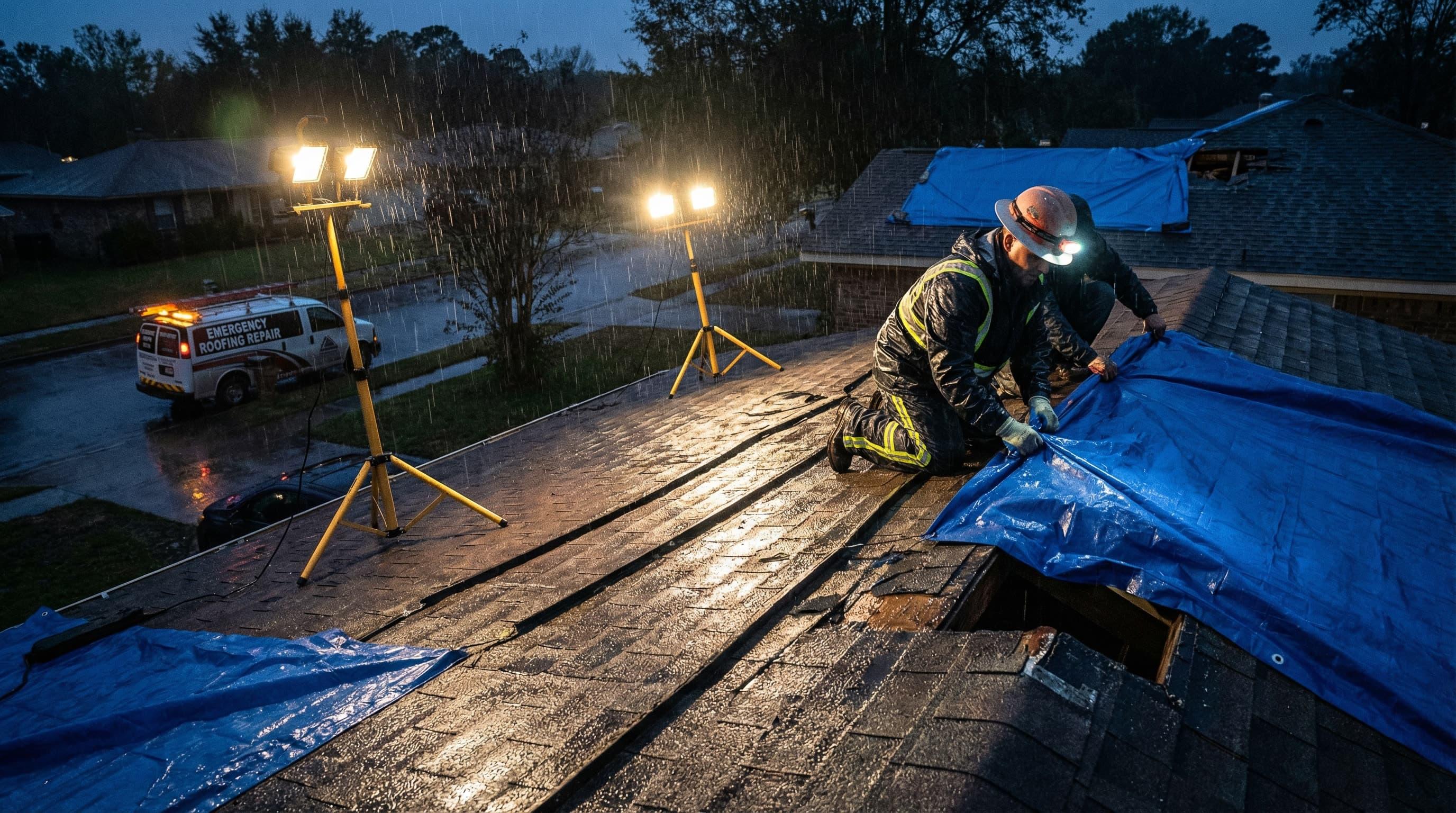
Emergency tarping is the immediate response to stop water intrusion before a permanent repair can be completed. It is not a repair — it is protection. A properly installed emergency tarp:
- Stops active water entry at the breach point
- Prevents the damage cascade from progressing during scheduling delays
- Documents the damage area for insurance adjusters
- Creates a weatherproof barrier for days to several weeks depending on conditions
Emergency Tarping Costs in Seattle
| Service | Typical Seattle Range | Notes |
|---|
| Emergency tarp — small area (under 200 sq ft) | $300–$500 | Contained breach, accessible roof |
| Emergency tarp — full section (200–800 sq ft) | $500–$800 | Larger exposure, moderate pitch |
| Emergency tarp — complex or steep roof | $800–$1,200+ | High pitch, difficult access, large area |
| After-hours / weekend premium | +25–50% | Standard for all emergency services |
The National Roofing Contractors Association notes that emergency response pricing reflects mobilization costs, insurance coverage for working in adverse conditions, and the priority-scheduling overhead that legitimate contractors carry.
How Long Does a Tarp Last?
An emergency tarp is a temporary measure. Properly installed — weighted at the edges, secured to prevent wind displacement, overlapping ridge and flashing points — a quality tarp can last 2–6 weeks under Seattle conditions. It is not designed to survive multiple major storm events.
The goal of tarping is to buy time for a permanent repair to be scheduled. Most Seattle contractors will attempt to complete permanent repairs within 1–2 weeks of an emergency tarp installation, weather and materials permitting.
Do not let a tarp sit for months. Tarps shift, degrade, and allow water infiltration — and insurers sometimes contest claims where damage continued under a tarp that wasn't followed up with permanent repair.
The Permanent Repair Process After an Emergency
Once the immediate leak is stopped, here's what the full repair process looks like.
Inspection and Damage Assessment
With the roof made safe by tarping or favorable weather, the contractor completes a full damage assessment. This includes:
- Removing the tarp to inspect what's underneath
- Checking for decking damage in the breach area (soft spots, delamination, rot)
- Assessing flashing, surrounding shingles, and adjacent areas
- Photographing all findings for your insurance file
In Seattle's wet climate, even a small breach can saturate decking within a single rain event. Don't be surprised if the inspection reveals more damage than the visible exterior suggested.
What Permanent Repairs Typically Cost
The cost of permanent repair after an emergency depends entirely on what the inspection finds. Use these ranges as a starting framework:
| Repair Type | Typical Range | Notes |
|---|
| Shingle section replacement | $400–$1,200 | Depends on area; includes decking check |
| Flashing replacement | $500–$1,000 | Chimney, valley, skylight, vent |
| Deck/sheathing repair | $600–$2,500 | Priced by sq ft of rot found |
| Storm damage — multiple areas | $2,000–$6,500+ | Scope-dependent |
Our roof repair service handles all permanent repairs after emergency containment. For a complete breakdown of Seattle roof repair costs by type, see our Seattle roof repair cost guide.
Permit Requirements for Emergency Repairs
The Seattle SDCI Emergency Repair Permit/emergency-repair-permit) allows work to begin immediately in genuine emergencies, with permit documentation following. For standard repairs under 500 square feet on single-family homes, no permit is required. Larger or more complex repairs — or re-roofing over 500 sq ft — require a standard re-roof permit from SDCI/re-roof-permit).
A licensed contractor handles permit requirements as part of their scope. If a contractor tells you permits aren't needed for significant structural work, ask them to show you the specific exemption.
How to File Your Insurance Claim for Emergency Roof Damage
Seattle homeowners whose damage was caused by a storm event — wind, hail, falling trees or branches — are generally covered under standard homeowners insurance policies. Here's how to handle the process correctly.
Washington State Insurance Timelines
Washington State law gives insurers specific response deadlines:
- Acknowledge your claim within 10 business days
- Accept or deny a fully completed claim within 15 business days
- If additional investigation is needed, they must notify you within 15 days explaining the delay
Keep your own timeline. If an insurer goes silent past these deadlines, document the gap and escalate through the Washington State Office of the Insurance Commissioner.
Step-by-Step Claim Process
- Document everything first — photos, videos, dates, weather records (before any repairs are started)
- Call your insurer to report the claim; have your policy number, date/time of damage, and photos ready
- Get a professional inspection from a licensed contractor before the adjuster arrives — your own documentation protects you
- Know your rights: You have the legal right to select your own contractor in Washington State. Your insurer cannot require you to use their preferred vendors
- Submit your contractor's written estimate to the insurer; this becomes the basis for your settlement
- Understand what's covered: Sudden storm damage is covered; age-related wear, moss damage, and deferred maintenance are not
- Save all receipts for emergency tarping, temporary repairs, and interior damage — all of these are typically reimbursable under a valid claim
For storm-related damage requiring full insurance advocacy and restoration, our storm damage repair services handle documentation, adjuster meetings, and complete repairs.
FEMA Assistance for Major Disasters
If the damage occurred during a federally declared disaster, FEMA disaster assistance may provide additional support for basic repairs — roof tarping, patching active leaks — beyond what your insurance covers. For federally declared disaster events, the current FEMA maximum assistance is approximately $42,500 per household. FEMA assistance requires proof of primary residence ownership and a registered claim.
What Insurance Does NOT Cover
- Normal wear and tear or age-related shingle deterioration
- Moss damage (classified as a maintenance issue by most insurers)
- Pre-existing conditions that were present before the storm
- Repairs that were deferred and compounded over time
If an insurer denies your claim and you believe the damage is legitimate storm-related, a public adjuster or the Washington Insurance Commissioner can help you evaluate your options.
How to Verify You're Hiring a Licensed Seattle Roofing Contractor
In the chaos of a storm emergency, hiring an unlicensed contractor is a real risk. Storm chasers — often out-of-state crews following weather events — target Seattle neighborhoods after major storms, offering fast turnaround at below-market prices. They take deposits and deliver substandard work or none at all.
Before You Hire Anyone
Verify the contractor's Washington L&I license using the L&I contractor lookup tool. Confirm the license is:
- Active (not expired or suspended)
- Bonded — provides financial protection if the contractor fails to complete the work
- Insured — protects you from liability if a worker is injured on your property
Also confirm they carry workers' compensation coverage. Without it, an injured worker can pursue a claim against your homeowner's insurance.
The BBB guidance on emergency roofing contractors highlights these as the minimum verification steps before authorizing any work, especially in an emergency situation where pressure to decide quickly is highest.
Our full guide to choosing a Seattle roofing contractor walks through the complete vetting process.
Frequently Asked Questions
How fast can I get emergency roof repair in Seattle?
Most reputable Seattle emergency roofing companies respond within 2–4 hours for active leaks or storm damage. Response times extend during peak demand following major storm events. Call multiple companies simultaneously if the damage is severe — whoever can respond fastest wins the job.
How much does emergency roof repair cost in Seattle?
Emergency tarping to stop an active leak typically costs $400–$800 in Seattle, with after-hours and weekend calls carrying a 25–50% premium above that base. Permanent emergency repairs run $1,200–$4,500+ depending on damage scope. The cost is almost always far less than the cascade damage that a Seattle rain event will cause to an unaddressed breach.
Can I do a temporary roof repair myself?
You can apply temporary roofing tape or sealant from the interior or attic side, and you can place buckets and plastic sheeting to protect the interior. Do not climb on a wet roof — even a moderate pitch becomes extremely dangerous in Seattle's rain. Falls from roofs are a leading cause of serious home contractor injuries; in wet conditions, the risk is acute. Let the professionals handle any exterior work.
What does emergency roof tarping cost and how long does it last?
Emergency tarping in Seattle runs $300–$1,200 depending on area size, roof pitch, and whether the job is after hours. A properly installed tarp lasts 2–6 weeks under normal Seattle conditions. It is not a permanent fix — it buys time for a scheduled repair. Don't let it sit for months; tarp degradation can allow water infiltration and may complicate your insurance claim.
Will homeowners insurance cover my emergency roof repair?
If the damage was caused by a sudden, accidental event — windstorm, hail, a falling tree — standard homeowners insurance in Washington State covers it. Age-related wear, moss damage, and pre-existing conditions are not covered. Document the damage thoroughly before any work begins and file your claim promptly. You have the legal right to select your own contractor.
Do I need a permit for emergency roof repairs in Seattle?
Seattle SDCI has an emergency repair permit process that allows work to begin immediately for genuine emergencies. Minor repairs under 500 sq ft on single-family homes typically don't require a permit. Larger repairs or re-roofing over 500 sq ft require a standard re-roof permit/re-roof-permit). A licensed contractor handles permit requirements as part of their scope.
How do I tell if the emergency repair is from storm damage or old age?
Storm damage tends to be sudden, localized, and correlates with a specific weather event — missing shingles after a windstorm, punctures from hail or debris, breach at a flashing joint stressed by water volume. Age-related failure tends to be gradual, widespread, and not tied to a single event — granule loss across large sections, widespread cracking or curling, multiple small failures appearing together. Insurance covers the former; the latter is a sign it's time for a roof replacement evaluation.
What happens if I ignore a small roof leak in Seattle?
A small leak in Seattle rarely stays small. The damage cascade is well-documented: days 1–3, water soaks insulation (adds $800–$1,500 to repair cost); week 1–2, decking begins to saturate and soften (adds $600–$2,000); month 1+, mold begins establishing in wet insulation and wood (adds $3,000–$12,000 for remediation); several months, structural rot begins in rafters and decking (adds $8,000–$25,000). Seattle's near-constant rain means standing water almost never has time to dry out between events.
Is a roof leak an emergency?
A roof leak is an emergency when water is actively entering the living space, there's visible structural damage, water is near electrical systems, or multiple areas are leaking simultaneously. In Seattle's rainy climate, even a small leak rarely resolves on its own — the next rain event almost always makes it worse. When in doubt, treat it as an emergency.
Who should I call if my roof collapses in Seattle?
If your roof partially or fully collapses, call 911 immediately if anyone is in danger, then evacuate the building. Once everyone is safe, call your insurance company to report the claim, then contact a licensed emergency roofing contractor. Document everything with photos before any work begins — that documentation is critical for your insurance settlement.
What is the 25% rule for roofing?
The 25% rule states that if your repair cost exceeds 25% of total replacement cost, a full replacement is often the smarter financial decision. For Seattle homes where replacement averages $12,000–$28,000, that threshold is roughly $3,000–$7,000. Roof age matters too — an older roof near this threshold almost always warrants a replacement evaluation rather than another repair.
Call for Emergency Service — We Respond 24/7
If your roof is actively leaking, don't wait to see if it gets better on its own. In Seattle's climate, it won't.
The Seattle Roofing Company provides 24/7 emergency roof repair across Seattle, Bellevue, Renton, Tacoma, Kirkland, Redmond, and the greater King, Pierce, and Snohomish County area. We arrive with tarps, materials, and the equipment to stop the damage now — and the inspection capability to document everything you need for your insurance claim.
Call [(253) 345-4607](tel:2533454607) for immediate emergency response, or [contact us online](/contact) if the situation allows a callback.
For non-emergencies, browse our related guides:
Reliable. Durable. Built for Northwest Weather.
Roof Leaking Right Now? Call (253) 345-4607 — we respond 24/7. GAF Certified · IKO ROOFPRO · Directorii Elite · Washington State Licensed & Insured.

 Roofing Tips