Quick Answer: For most Seattle homeowners, a pitched roof is the better choice. Seattle's 37+ inches of annual rainfall, heavy moss growth, and year-round damp conditions favor sloped roofs that shed water naturally. Flat roofs cost less upfront ($7.50–$14.50/sq ft installed) but require meticulous drainage maintenance and have shorter lifespans (15–25 years) in our climate. Flat roofs do make sense for commercial buildings, modern architectural homes, or additions where a pitched structure isn't feasible — but only with premium waterproofing systems and a maintenance plan. A local Seattle roofer can help you decide based on your specific property.
Choosing between a flat roof vs. pitched roof isn't just a matter of aesthetics — in Seattle, it could be one of the most consequential decisions you make for your home. Our climate is notoriously demanding on roofing systems. Seattle sees an average of 150+ rainy days per year, heavy moss and algae growth from Douglas firs and cedars, and occasional heavy snow events that test any roof's structural limits. A roof that performs beautifully in Phoenix or Atlanta can fail within a decade here if it's wrong for the Pacific Northwest.
In this guide, we break down the flat roof vs. pitched roof debate specifically for Seattle and King County conditions — covering drainage, materials, costs, lifespans, building code requirements, and when each roof type actually makes sense. By the end, you'll have a clear picture of which direction fits your home.
Seattle's Climate: Why Roof Type Matters More Here Than Anywhere
Seattle's weather creates a uniquely punishing environment for roofing. Understanding it is the starting point for any honest roof comparison.
Annual rainfall: Seattle averages 37–39 inches of rain per year, with most falling October through April. That's not the most rainfall of any U.S. city, but it's delivered in long, persistent rain events — not short, intense downpours. This steady moisture means roofing systems have little time to fully dry out between rains.
Biological growth: The same moisture and mild temperatures that make Seattle green also feed relentless moss, algae, and lichen. Evergreen canopy covers much of Bellevue, Sammamish, Shoreline, and most Seattle neighborhoods, blocking sunlight and keeping roof surfaces damp. Moss holds moisture against roofing materials and, on flat roofs, can block drainage systems within a single season.
Snow and freeze events: While heavy snow is infrequent, Seattle does experience ice storms and moderate snowfall. Flat roofs accumulate snow load differently than pitched roofs and require careful structural consideration.
Drainage speed: On a pitched roof, gravity clears water quickly — within hours of a rain event. On a flat roof, water drains only as fast as the drain system allows, and any blockage, sag, or installation defect creates ponding water that accelerates membrane failure.
These factors together explain why over 90% of Seattle residential homes are built with pitched roofs, and why flat roofing contractors in the area consistently emphasize that drainage design and regular maintenance are non-negotiable in the Pacific Northwest.
Flat Roof vs. Pitched Roof: Side-by-Side Comparison
| Factor | Flat Roof | Pitched Roof |
|---|
| Installation cost (installed) | $7.50–$14.50/sq ft | $9–$18/sq ft (material-dependent) |
| Lifespan in Seattle | 15–25 years | 20–70+ years (material-dependent) |
| Drainage | Requires designed drainage systems; prone to ponding | Gravity-fed; self-draining |
| Moss/algae risk | High — debris clogs drains; organic growth thrives | Moderate — pitchier slopes shed growth better |
| Maintenance frequency | High — seasonal drain clearing required | Moderate — inspections every 2–3 years |
| Snow load handling | Accumulates; structural design critical | Sheds naturally on steeper pitches |
| Usable rooftop space | Yes — deck or mechanical equipment | No |
| Common Seattle materials | TPO, EPDM, modified bitumen | Asphalt shingles, metal, cedar shake |
| Best for | Commercial, modern multi-family, specific additions | Residential homes, standard new construction |
| Seattle building code slope | Min. 2% (1/4":12") required | Varies by material (3:12 to 4:12 typical) |
A few key takeaways: flat roofs offer usable space and a lower installed cost per square foot compared to premium pitched materials like metal, but their shorter lifespans and higher maintenance burden in Seattle often erode that upfront savings. Pitched roofs require less active management and perform more predictably in our climate.
Flat Roofs in Seattle: Materials, Pros & Cons
Flat roofing isn't truly flat — Seattle's building code Section 1502 requires a minimum slope of 1/4 inch per foot (2%) for drainage. When that slope is properly maintained and the drainage system is sized correctly, flat roofs can work well in Seattle. The challenge is everything that can go wrong in between.
The three common flat roof systems used in Seattle:
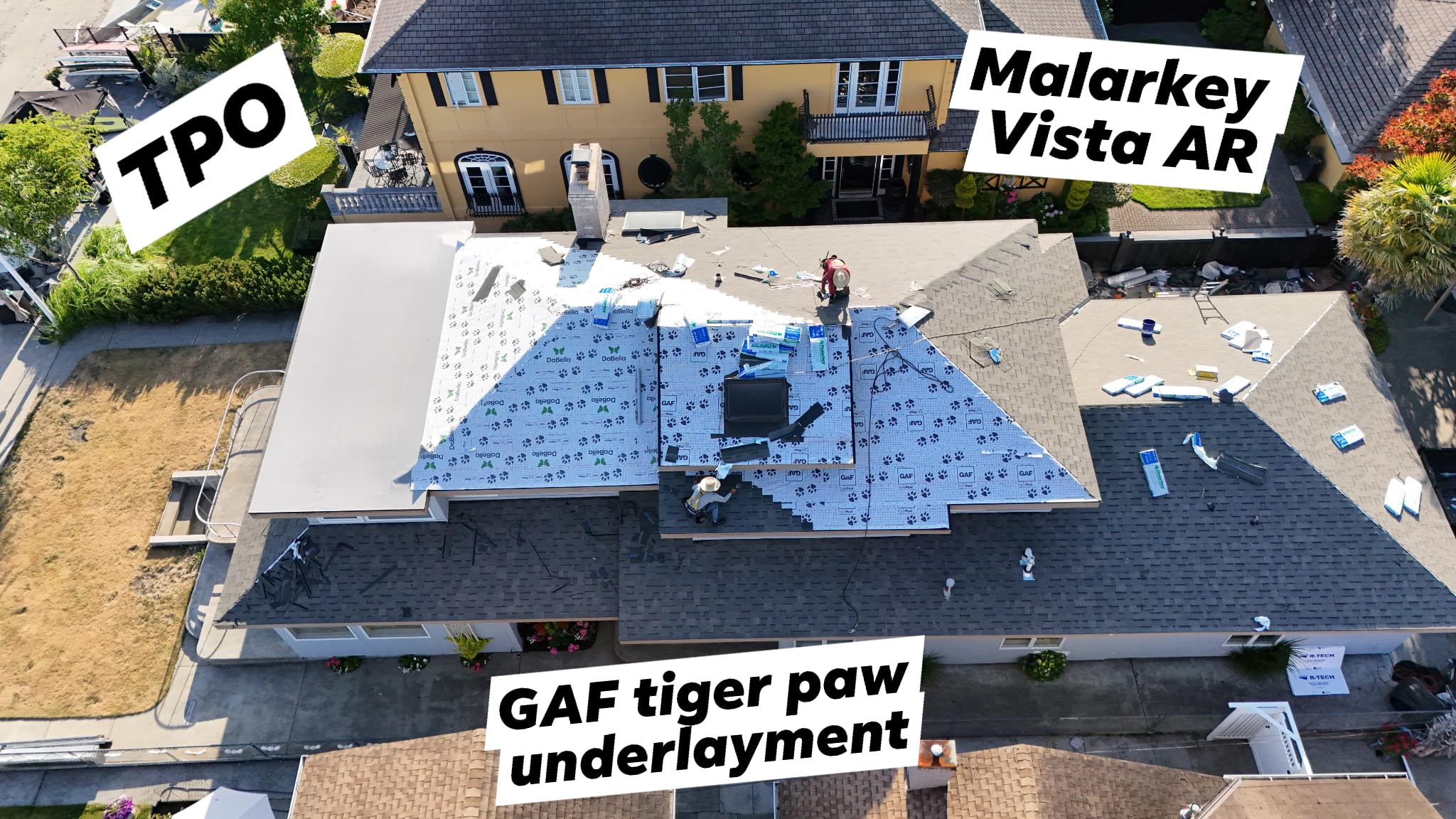
TPO (Thermoplastic Polyolefin) is currently the most popular commercial flat roof material in the region. Heat-welded seams create a watertight single-ply membrane. TPO costs roughly $4–$10/sq ft installed, lasts 15–25 years, and is energy-efficient (white reflective surface). It's the best flat roof choice for Seattle commercial and multi-family buildings due to its seam strength and UV resistance.
EPDM (Ethylene Propylene Diene Monomer) is the rubber membrane flat roofing system with the longest track record. It costs $4–$8/sq ft installed and can last 20–35 years with professional installation and proper maintenance. EPDM has excellent flexibility through Seattle's freeze-thaw cycles, making it well-suited for residential flat sections or commercial structures. The National Roofing Contractors Association (NRCA) recognizes EPDM as a proven system for low-slope applications.
Modified bitumen is a heritage system that predates single-ply membranes. It costs $4–$7.50/sq ft installed, lasts 10–20 years without recoating (up to 30 with maintenance), and is widely used for residential flat additions and low-slope sections. It requires recoating every 10–12 years and is more vulnerable to puncture than TPO or EPDM.
Where flat roofs struggle most in Seattle: Leaves, twigs, and needles from Douglas firs and cedars clog drains within weeks during fall. Ponding water — standing water that remains on the roof after a rain event — is the leading cause of flat roof failure locally. According to Seattle's Stormwater Code/stormwater-code), roof drainage must discharge at least 5 feet from foundation walls, and secondary emergency overflow drains with scupper openings of at least 4 inches are required wherever roof perimeters extend above the roof surface.
When a flat roof makes sense in Seattle: Commercial and industrial buildings, modern architectural homes where aesthetic drives the design, rooftop decks or green roof installations, and low-slope additions where a pitched structure would conflict with the existing building or exceed budget.
Pitched Roofs in Seattle: The Residential Standard
The pitched roof is the default for Seattle residential construction — and for good reason. Gravity handles drainage automatically, reducing the risk of ponding and the maintenance burden that comes with flat roof drain management. Steeper pitches also shed moss more effectively than shallow slopes.
Common pitched roof materials in Seattle:
Asphalt shingles cover roughly 75–80% of Seattle-area homes. Architectural shingles typically last 20–30 years in Pacific Northwest conditions (shorter than manufacturer ratings due to our damp climate) and cost $4.50–$7.00/sq ft installed. They're the lowest upfront option and widely available from multiple Seattle roofing contractors. Products like GAF Timberline HDZ and IKO Dynasty include algae-resistant granules rated to reduce biological growth, which matters in Seattle.
Metal roofing is the premium pitched roof choice, lasting 40–70 years and offering superior moss resistance due to its smooth surface. Installed cost runs $10–$16/sq ft. Metal roofs are an excellent long-term investment for King County homeowners who plan to stay 20+ years. The U.S. Department of Energy notes that metal roofs can reduce cooling costs by 10–25%, though in Seattle's mild climate the thermal benefit is secondary to longevity.
Cedar shake is Seattle's heritage roofing material — beautiful, naturally insulating, and well-suited to Pacific Northwest aesthetics. However, cedar requires diligent moss treatment and periodic retreatment to avoid premature failure. Modern treated cedar products reduce this maintenance burden.
Slope and performance: Steeper pitches (6:12 and above) drain more aggressively and give moss fewer places to hold. Lower-slope pitched roofs (2:12 to 4:12) still outperform flat roofs in drainage but don't shed organic growth as effectively. The International Building Code (IBC) sets minimum slope requirements by material — asphalt shingles require a minimum 2:12 pitch with proper underlayment, while metal standing seam can perform at 1:12.
Which Should You Choose? A Seattle Homeowner's Guide
Choose a pitched roof if:
- You're replacing a residential roof (pitched is the standard and expected by Seattle buyers)
- Long-term value matters — a metal or quality asphalt pitched roof will outlast any flat roof system in our climate
- You want lower lifetime maintenance costs
- Your neighborhood has tree canopy that will deposit debris on a flat roof
- You're building or replacing a standard single-family home anywhere in King, Pierce, or Snohomish County
Choose a flat roof if:
- Your building is commercial or multi-family and a flat roof is standard for the construction type
- You need rooftop space for HVAC equipment, a deck, or a green roof
- Modern architectural aesthetics require a low-slope profile
- You're adding a flat-roofed addition to an existing structure where pitch would conflict with the design
- You're committed to a maintenance plan: semi-annual drain clearing, annual professional inspection, and periodic membrane assessment
The hybrid approach: Many Seattle properties combine both. A pitched main roof handles primary drainage while a flat-roofed addition, garage, or commercial section uses a TPO or EPDM system. This is often the best of both worlds — natural drainage where pitch is feasible, flat-roof versatility where the design requires it.
For flat roof questions and inspections, resources like Washington State's Department of Labor & Industries and the NRCA's Roofing Manual are authoritative references your contractor should know well.
Frequently Asked Questions
How long does a flat roof last in Seattle? Most flat roof systems last 15–25 years in Seattle with proper maintenance. EPDM can reach 30+ years; TPO typically performs 15–25 years; modified bitumen runs 10–20 years without recoating. Seattle's heavy rainfall and biological growth put flat roofs at the lower end of their rated lifespans without consistent drain maintenance.
Are flat roofs more expensive than pitched roofs in Seattle? Flat roofs are often less expensive per square foot to install ($7.50–$14.50) compared to premium pitched materials like metal ($10–$16/sq ft). However, pitched roofs with standard asphalt shingles ($4.50–$7.00/sq ft) are cheaper than flat roofs at similar quality levels. Factor in higher flat roof maintenance and shorter replacement cycles and pitched roofs typically win on lifetime cost.
Do flat roofs need a permit in Seattle? Yes. Flat roof installation or replacement on commercial and multifamily buildings (500+ sq ft) requires a permit through Seattle's Department of Construction and Inspections (SDCI)/re-roof-permit). Residential re-roofing without structural changes may be exempt — confirm with SDCI before starting work.
What is the best flat roof material for Seattle? TPO and EPDM are both well-suited to Seattle. TPO is preferred for commercial applications where energy efficiency and heat-welded seam strength matter. EPDM is the proven choice for residential flat sections and smaller commercial projects. Both outperform modified bitumen in Seattle's wet climate. Whichever system you choose, proper drainage design is more important than material selection.
How do I prevent ponding water on a flat roof in Seattle? Ensure your flat roof has the required minimum 2% slope, keep drains and scuppers clear of debris (especially during fall leaf drop), and schedule a professional inspection each spring to catch early ponding damage. Secondary overflow drains are required by Seattle code and provide a critical backup if primary drains block.
Can moss grow on a flat roof in Seattle? Yes — flat roofs are actually more vulnerable to moss and algae than steep pitched roofs because debris accumulates and retains moisture. Biostat treatments applied every 2–3 years help control growth. Regular drain clearing to prevent standing water is the most effective prevention.
What's the minimum slope for a flat roof in Seattle? Seattle Building Code Section 1502 requires a minimum slope of 1/4 inch vertical per 12 inches horizontal (roughly 2%) for modified bitumen and thermoset single-ply membrane roofs. This slope is required for drainage — "flat" roofs must still have some pitch to comply with code.
How do I know if my flat roof needs replacing? Signs include persistent ponding water 48+ hours after rain, visible membrane cracking or blistering, interior water stains, compressed or waterlogged insulation, and seam separations. An infrared moisture scan by a qualified Seattle roofing contractor can identify hidden moisture intrusion before visible damage appears.
Get a Professional Opinion for Your Seattle Property — Whether you're weighing flat vs. pitched, need a flat roof inspection, or want an estimate on a pitched roof replacement, Seattle Roofing Company serves King, Pierce & Snohomish Counties. GAF Certified · IKO ROOFPRO · Washington State Licensed & Insured. [Request your free estimate →](/contact) or call (253) 345-4607. No obligation.

 Roofing Tips