Quick Answer: In Seattle's wet marine climate, asphalt shingle roofs realistically last 17–25 years — significantly less than the 25–30 years manufacturers claim. Metal roofs last 40–70 years, cedar shake 20–30 years with maintenance, and tile 70–100+ years. Seattle's persistent moisture, 150+ rainy days annually, and endemic moss growth shorten every material's lifespan compared to drier U.S. markets. The average age of replaced Seattle roofs is around 17 years.
When a roofing manufacturer says "30-year shingle," they're not lying — but that rating reflects performance in average national conditions, not in the Puget Sound's cool, damp, moss-prone marine climate. Seattle homeowners routinely discover their "30-year" roof needs replacement at 18 or 22 years. Understanding why — and what that means for every common roofing material — helps you plan accurately and make smarter decisions about repair vs. replacement.
Why Seattle's Climate Shortens Roof Lifespan
Before looking at specific materials, it's worth understanding the mechanisms that make the Pacific Northwest harder on roofs than most U.S. regions.
Constant moisture cycling. Asphalt shingles absorb water when wet and expand; they contract as they dry. In most U.S. climates, this cycle happens occasionally. In Seattle, it happens continuously — 150+ rainy days per year means shingles are regularly saturated and drying across an 8-month wet season. Over years, this repeated expansion and contraction causes cracking, cupping, and structural breakdown at a rate that doesn't occur in drier markets.
No extended dry periods. In places like Arizona or Texas, roofs get months of continuous drying that reset moisture-related damage. Seattle's marine climate rarely delivers more than a few weeks of consistently dry weather. Roofs stay damp longer, and organic materials (moss, algae, lichen) establish and maintain themselves much more easily.
Moss, algae, and lichen. These organisms are the Pacific Northwest's most damaging roof factor and the least acknowledged in national roofing guides. Moss physically lifts shingle edges, retains moisture against the surface 24/7, strips protective granules, and promotes rot in any wood components below. A well-maintained Seattle roof and an identical neglected one can differ by 10+ years in useful life.
Tree shade. Heavily wooded Seattle neighborhoods trap shade on roof surfaces, extending drying time and creating exactly the cool, damp, low-UV conditions that moss and algae prefer.
Washington's climate data from NOAA/weather.gov shows Seattle averages 37+ inches of annual rainfall spread over 150+ days — with the wet season running roughly October through May. That's more rainy days than Miami, Portland, or New York, creating roofing conditions that genuinely belong in their own category.
Roof Lifespan by Material in Seattle
Asphalt Shingles: The Most Common Choice
Asphalt shingles cover the vast majority of Seattle homes. They're the most affordable option and offer solid performance — if expectations are calibrated for the Pacific Northwest reality.
3-Tab Shingles: The thinner, older style of asphalt shingle. Nationally rated at 20–25 years; in Seattle, expect 15–20 years. 3-tab shingles are thinner and more susceptible to wind uplift and moisture penetration. They've largely been replaced by architectural shingles in new installations.
Architectural (Dimensional) Shingles: The current standard for residential roofing. Nationally rated at 25–30 years; in Seattle, expect 20–25 years with adequate maintenance. Architectural shingles are thicker, more wind-resistant, and hold up better to the expansion-contraction cycles of Seattle's weather.
Luxury/Designer Shingles: Heavier-weight products designed to mimic slate or wood. Nationally rated at 30–50 years; realistic Seattle lifespan is 25–35 years, making them worth considering for homeowners who don't want to re-roof again in 20 years.
The "30-Year Shingle" Reality: Multiple studies and contractor reports from the Pacific Northwest consistently find that the average age of replaced asphalt shingle roofs in Seattle is around 17 years — a full 13 years below the manufacturer's rated lifespan. The NRCA acknowledges that moisture-heavy climates materially shorten asphalt shingle service life. GAF roofing materials explicitly recommends algae-resistant product lines for the Pacific Northwest for this reason.
If choosing asphalt for a Seattle home, invest in algae-resistant shingles with copper granules, and budget for professional moss treatment every 2–3 years. This maintenance approach can add 5–7 years to the roof's service life.
Metal Roofing: The Pacific Northwest's Best Long-Term Choice
Metal roofing performs better in Seattle's climate than any other common option, and the performance gap widens over time.
Standing Seam Metal: The premium option, with concealed fasteners and floating-panel design that accommodates thermal movement. Expected lifespan in Seattle: 40–70 years. Metal is inherently resistant to moss (no granules to strip, no organic surface for rhizoids to grip), sheds heavy rainfall efficiently, and handles the wet-dry cycling that damages asphalt far better.
Exposed Fastener Metal Panels: Less expensive, but the exposed fasteners corrode in Seattle's wet climate — typically within 10–15 years — requiring resealing or replacement. Overall lifespan: 20–30 years in the Pacific Northwest.
The upfront cost of standing-seam metal is 2–3x that of asphalt, but when you compare on a per-year basis over the life of the roof, the gap narrows substantially. A metal roof at $25,000 lasting 55 years costs $455/year. An asphalt roof at $15,000 lasting 22 years costs $682/year — and you've also paid to re-roof once before the metal roof needs attention.
Cedar Shake: Beautiful, Demanding, and Climate-Sensitive
Cedar shake has been installed on Pacific Northwest homes for generations, and it performs well here compared to other wet climates. But it demands consistent maintenance to reach its rated lifespan.
With proper maintenance (treatment every 3–5 years, regular cleaning, debris removal): Cedar shake in western Washington lasts 20–30 years, sometimes longer on well-ventilated roofs with good sun exposure.
Without maintenance: Cedar's natural decay resistance is real but finite. In Seattle's persistent moisture, unmaintained cedar shake can fail in 12–18 years, with splitting, cupping, and moss-driven rot compressing the roof's service life dramatically.
Cedar requires more hands-on investment than asphalt or metal — it's not a "set and forget" material in the Pacific Northwest. For homeowners who want the aesthetic and are willing to maintain it, cedar can be a long-lasting, attractive choice. For homeowners who prefer minimal maintenance, asphalt or metal is a better fit.
Tile Roofing: Exceptional Longevity, Significant Caveats
Clay and concrete tile offer the longest lifespan of any common residential roofing material — but they come with important Seattle-specific considerations.
Clay Tile: Rated at 70–100+ years, and in Seattle's mild, non-freeze climate (we rarely see sustained hard freezes that crack tile), that rating is realistic for the tile surface itself. However, the underlayment beneath the tile needs replacement every 20–30 years even when the tile is intact — meaning tile ownership involves a mid-life underlayment project.
Concrete Tile: Similar profile to clay, with a lifespan of 40–75 years in Seattle. Less expensive than clay, heavier, and slightly more susceptible to moisture absorption over decades.
The weight caveat: Tile is heavy. Many Seattle homes built before the 1980s lack the structural framing to support tile without reinforcement. A structural engineer assessment is necessary before any tile installation on an older home.
TPO and Flat Roofing: For Low-Slope Applications
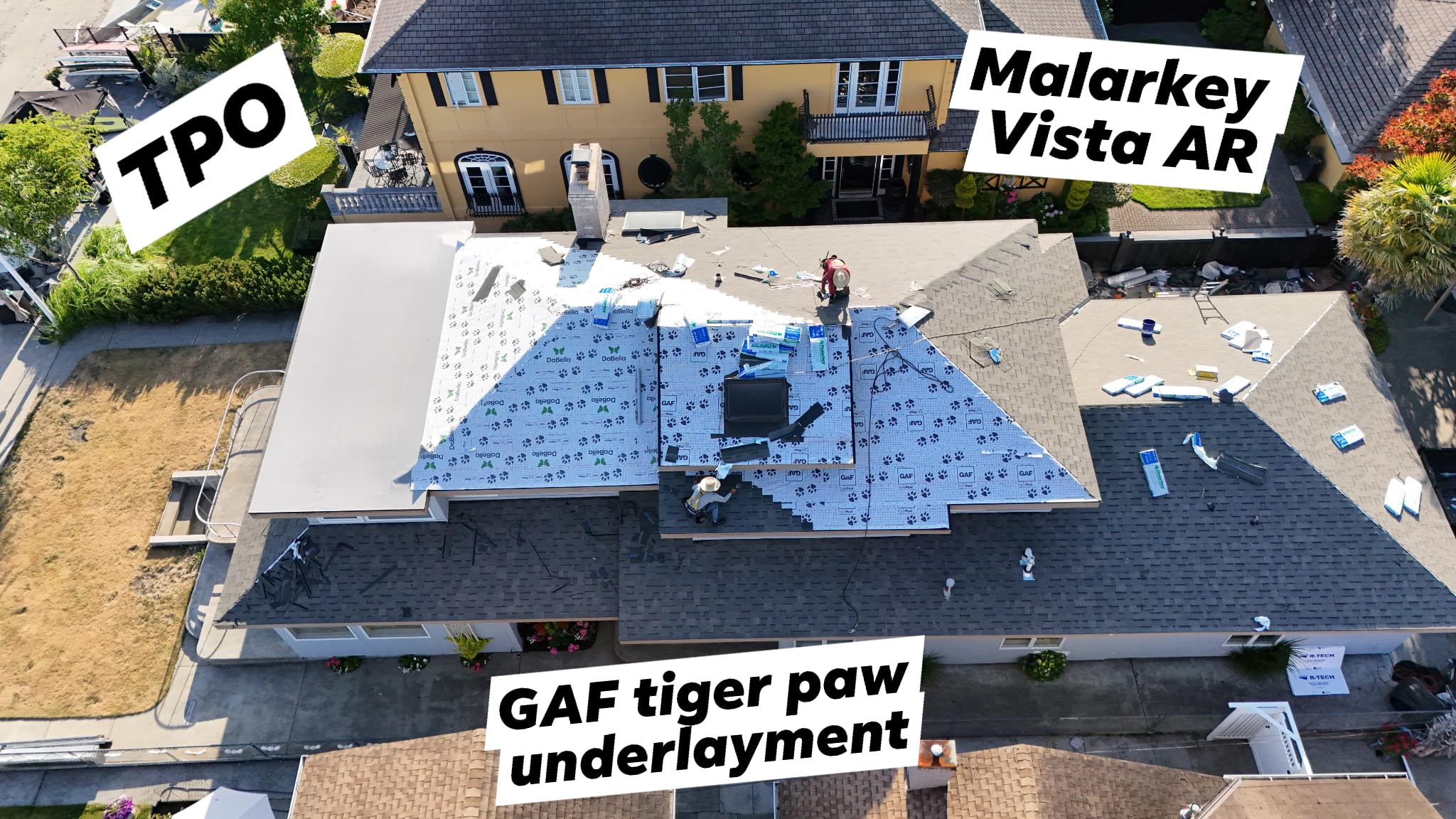
Many Seattle commercial buildings, additions, and flat-roof homes use TPO (thermoplastic polyolefin) or modified bitumen membranes.
TPO Roofing: Manufacturer-rated at 25–30 years; realistic Seattle lifespan is 20–25 years. TPO actually benefits from Seattle's mild temperature range — the extreme heat cycles that stress TPO seams in hotter climates are largely absent here. The critical factor in Seattle is drainage: flat roofs must drain completely to prevent ponding, which stresses seams and accelerates membrane breakdown.
Modified Bitumen: A more traditional flat-roof option with a lifespan of 15–25 years in the Pacific Northwest. Requires regular inspection of seams and membrane surface.
The U.S. Department of Energy's guidance on roofing systems notes that cool-roof membranes like TPO perform particularly well in marine climates due to their reflective properties and moisture resistance.
Seattle Roof Lifespan by Material: Full Comparison Table
| Roofing Material | Manufacturer Rating | Realistic Seattle Lifespan | Maintenance Requirement | Key Seattle Factor |
|---|
| 3-Tab Asphalt | 20–25 yrs | 15–20 yrs | Moderate | Moisture cycling, moss |
| Architectural Asphalt | 25–30 yrs | 20–25 yrs | Moderate | Moss treatment critical |
| Luxury Asphalt | 30–50 yrs | 25–35 yrs | Moderate | Better thickness = better longevity |
| Cedar Shake (maintained) | 30–40 yrs | 20–30 yrs | High | Rot risk without regular treatment |
| Standing Seam Metal | 40–70 yrs | 40–70 yrs | Low | Best PNW performance |
| Exposed Fastener Metal | 20–30 yrs | 20–25 yrs | Low-Moderate | Fastener corrosion |
| Clay Tile | 70–100+ yrs | 70–100+ yrs* | Low | *Underlayment every 20–30 yrs |
| Concrete Tile | 40–75 yrs | 35–60 yrs* | Low | *Underlayment every 20–30 yrs |
| TPO (flat/low-slope) | 25–30 yrs | 20–25 yrs | Moderate | Drainage critical |
| Modified Bitumen | 20–30 yrs | 15–25 yrs | Moderate | Seam inspection important |
The Moss Factor: How Much Lifespan Does It Cost?
Moss deserves its own section because it's the single biggest variable in Seattle roof lifespan — one that homeowners can actually control.
Research and field data from Pacific Northwest roofing contractors consistently shows:
- Unmaintained Seattle roofs (no moss treatment, no regular inspection): Asphalt shingle lifespan of 12–17 years
- Actively maintained Seattle roofs (moss treatment every 2–3 years, semi-annual inspection): Asphalt shingle lifespan of 22–27 years
That's a 5–15 year difference driven almost entirely by moss management. The cost of professional moss treatment runs $300–$600 per visit. Over a 25-year roof lifespan with treatment every 3 years, that's approximately $2,500–$5,000 in maintenance cost — in exchange for potentially 10 additional years of roof service life and delayed replacement costs of $12,000–$28,000.
The math is straightforward: moss treatment is one of the highest-ROI maintenance investments a Seattle homeowner can make.
Washington State's licensed contractor requirements (LNI) apply to roofing work — verify any contractor you hire for moss treatment or roofing work holds a current Washington contractor license.
How to Extend Your Seattle Roof's Lifespan
Regardless of material, proactive maintenance is the most impactful variable you control.
For asphalt shingle roofs:
- Professional moss treatment every 2–3 years (zinc strips at the ridge provide ongoing prevention between treatments)
- Semi-annual inspection (fall + spring)
- Gutter cleaning to prevent water backup at the roof edge
- Prompt repair of any flashing failures before water reaches the deck
- Algae-resistant shingles if replacing or reroofing
For cedar shake roofs:
- Treatment with wood preservative every 3–5 years
- Annual debris removal (leaves and debris accelerate moisture retention)
- Moss treatment as needed — cedar is not immune
- Replace split or broken shakes promptly to prevent water infiltration
For metal roofs:
- Annual visual inspection of fasteners (if exposed fastener style) and sealant at penetrations
- Clear debris from valleys and around penetrations
- Check seam condition every 5–10 years on standing seam installations
For flat roofs (TPO, modified bitumen):
- Verify complete drainage after every significant rain event
- Inspect seams annually
- Clear drains of debris seasonally
The Seattle Department of Construction and Inspections (SDCI) recommends regular roof maintenance and inspection as part of routine property upkeep — and permits are required for full roof replacements in Seattle.
When to Replace vs. Repair Your Seattle Roof
Knowing your roof's realistic lifespan in Seattle helps with the repair-or-replace decision:
Lean toward repair if:
- The roof is under 15 years old (asphalt) or has substantial remaining life
- Damage is isolated to one area (a section of missing shingles, a single failed flashing)
- Repair cost is less than 15% of estimated replacement cost
- No interior water damage or structural concerns
Lean toward replacement if:
- The roof is 18+ years old (asphalt) and showing multiple signs of wear
- Repair cost exceeds $1,800–$4,200 (15% of Seattle's typical replacement range)
- Multiple leak locations exist
- Moss has established under shingles and lifted edges across significant area
- Interior water damage indicates moisture has reached the deck
- The roof deck itself shows rot or soft spots
See our full roof repair vs. replacement guide for a detailed decision framework.
Frequently Asked Questions
How long do asphalt shingles actually last in Seattle?
Realistically, 17–25 years for architectural shingles with adequate maintenance, and 15–20 years for 3-tab shingles. The manufacturer's "30-year" rating reflects testing in average national conditions — Seattle's persistent moisture, moss, and wet cycling reduce that number significantly. The average age of replaced Seattle asphalt roofs is around 17 years.
What roofing material lasts longest in Seattle's wet climate?
Standing seam metal roofing is the clear winner at 40–70 years. Clay tile lasts 70–100+ years but requires structural consideration and underlayment replacement. For most homeowners balancing cost, longevity, and maintenance, standing seam metal delivers the best lifecycle value in the Pacific Northwest.
Does moss really shorten my roof's lifespan in Seattle?
Yes, significantly. Unmaintained Seattle roofs with heavy moss growth routinely need replacement 5–15 years earlier than maintained roofs. Moss retains moisture against shingles continuously, lifts shingle edges, strips granules, and promotes rot. Professional moss treatment every 2–3 years is one of the best investments Seattle homeowners can make.
Is metal roofing worth the higher upfront cost in Seattle?
For most Seattle homeowners planning to stay in their home long-term: yes. Standing seam metal at $20,000–$35,000 lasting 55 years works out to lower annual cost than asphalt at $12,000–$22,000 lasting 22 years — and the second asphalt roof has to be paid for while the metal roof is still going strong. Metal also eliminates moss-related maintenance costs entirely.
How often should I have my Seattle roof inspected?
Twice a year: fall (before the wet season begins) and spring (to assess any winter damage). Professional inspections every 2–3 years are worth scheduling even if you're doing your own visual checks — many problems at flashings, valleys, and penetrations aren't visible from the ground or from binoculars.
What happens if I ignore an aging Seattle roof?
An ignored aging roof in Seattle accelerates damage rapidly. Moss spreads, shingles lift, water infiltrates the deck, rot sets in, and eventually water reaches interior spaces — causing ceiling damage, mold, insulation failure, and structural deterioration. What might cost $15,000 to replace cleanly can require $20,000–$30,000 when deck replacement, mold remediation, and interior repairs are added. Early action is almost always cheaper.
When is the best time to replace a roof in Seattle?
June through September offers the most reliable dry weather for roofing installation, and many contractors are booked well in advance during these months. That said, experienced Seattle roofing contractors work year-round. If your roof is failing or actively leaking, don't delay until summer — the interior damage from waiting through another wet season typically costs more than any weather-related inconvenience to the installation.
Do I need a permit to replace my roof in Seattle?
Yes. The Seattle Department of Construction and Inspections requires permits for full roof replacements. Your roofing contractor should pull the required permits — if a contractor proposes working without permits, treat that as a significant red flag about their license status and the quality of their work.
Plan Ahead for Your Seattle Roof
Whether you're trying to understand how many years your current roof has left or planning for a future replacement, the most useful step is a professional evaluation by a contractor who can inspect the roof surface — not just estimate from the ground.
The Seattle Roofing Company has completed 500+ roofs across King, Pierce, and Snohomish Counties. We serve Seattle, Bellevue, Renton, Tacoma, Kirkland, Redmond, and surrounding communities. We'll give you an honest assessment of your roof's remaining life and replacement options, with no pressure toward a sale you don't need.
[Request a free estimate](/contact) or call (253) 345-4607 — we'll tell you exactly where your roof stands.
Reliable. Durable. Built for Northwest Weather.

 Roofing Tips