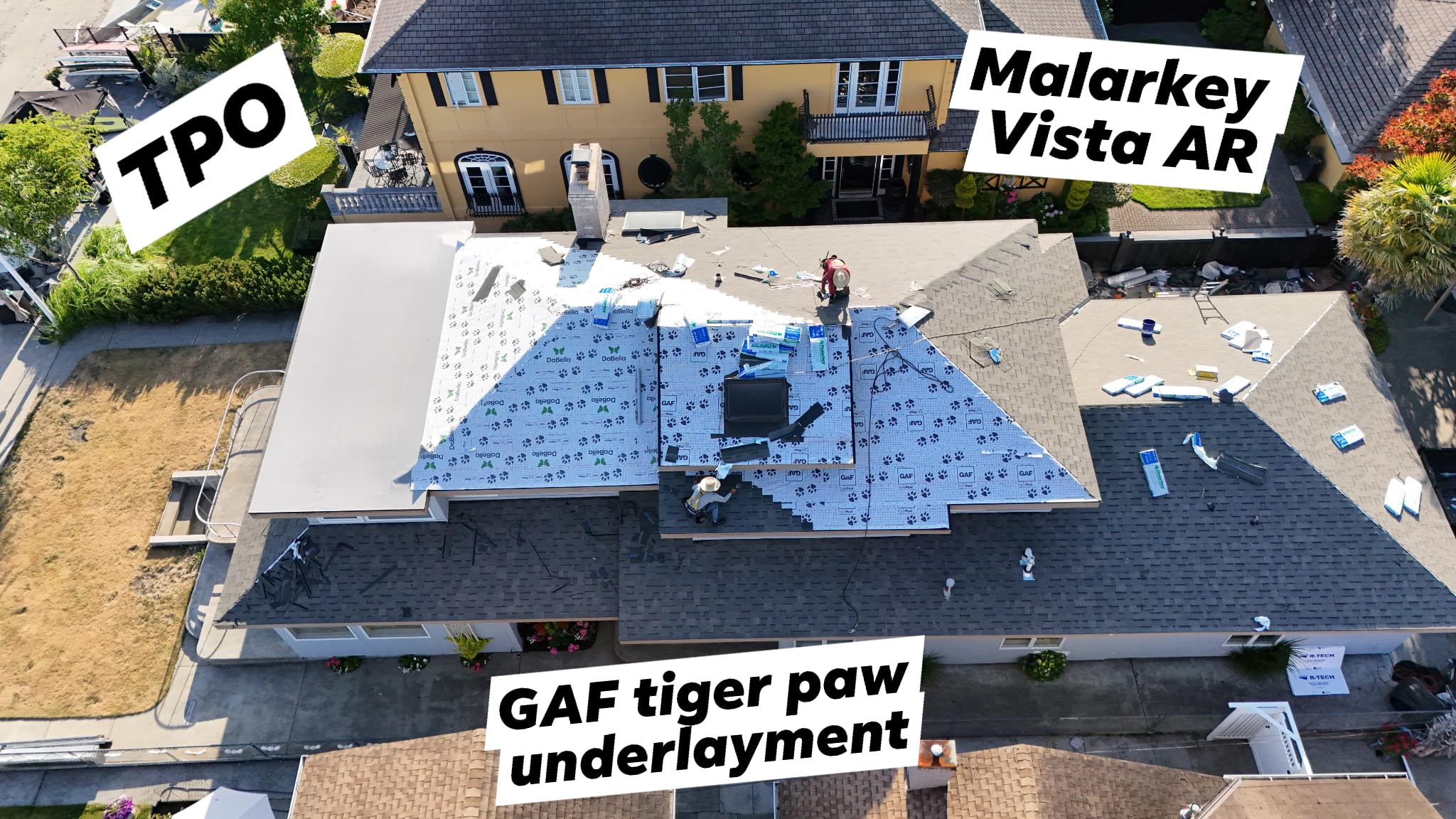
Quick Answer: Seattle's adopted building code — the 2021 Seattle Residential Code (SRC) based on IRC R905.1.2 — does not mandate ice and water shield for lowland residential roofs. Seattle's Table R301.2 designates ice barriers as NOT required, because the city's maritime climate rarely produces sustained freeze-thaw cycles at sea level. However, ice and water shield is strongly recommended by experienced Seattle roofers and required by shingle manufacturers for valleys, eaves, and penetration zones — regardless of local code. Skipping it on those vulnerable areas voids manufacturer warranties and leaves your roof exposed to the water infiltration most likely to cause interior damage.
Seattle gets more than 37 inches of rain per year. It gets occasional snow, freezing rain, and temperatures that dip into the mid-20s during Arctic air outbreaks. While the climate isn't as extreme as Spokane or Yakima, the Puget Sound basin creates its own set of moisture risks that ice and water shield is specifically designed to address.
This guide explains exactly what Washington State and Seattle code require, where ice and water shield should be installed even when code doesn't mandate it, how the leading products from GAF, IKO, and CertainTeed compare, and what to expect to pay in the Seattle market.
What is Ice and Water Shield?
Ice and water shield (also called ice barrier, self-adhering underlayment, or peel-and-stick membrane) is a rubberized asphalt sheet that self-adheres directly to the roof deck. Unlike standard felt or synthetic underlayments, ice and water shield:
- Creates a waterproof seal, not just a water-resistant layer
- Self-seals around fasteners — the membrane closes tightly around nails and staples rather than allowing water to track along the shank
- Adheres directly to the deck, preventing wind-driven rain from infiltrating under the membrane
- Bridges cracks and small gaps in sheathing joints
Standard underlayments (both felt and synthetic) are water-resistant, not waterproof. They rely on shingles above them to do the primary water-shedding work. Ice and water shield provides a true secondary waterproof layer at the most vulnerable locations on the roof.
Washington State and Seattle Code Requirements (IRC R905.1.2)
The Governing Code Section
Ice barrier requirements in Washington State fall under IRC R905.1.2 in the current 2021 Washington State Residential Code (WSRC). This section replaced the older R905.2.7.1 designation when the 2021 IRC consolidated all ice barrier language into a single section applicable to all roofing material types.
The rule text:
"In areas where there has been a history of ice forming along the eaves causing a backup of water as designated in Table R301.2, an ice barrier shall be installed for asphalt shingles, metal roof shingles, mineral-surfaced roll roofing, slate and slate-type shingles, wood shingles and wood shakes."
"The ice barrier shall consist of not fewer than two layers of underlayment cemented together, or a self-adhering polymer-modified bitumen sheet shall be used in place of normal underlayment and extend from the lowest edges of all roof surfaces to a point not less than 24 inches (610 mm) inside the exterior wall line of the building."
The code trigger is Table R301.2 — each jurisdiction fills in a YES or NO for "Ice Barrier Underlayment Required" based on their historical freeze conditions.
Is Ice and Water Shield Required in Seattle?
No — Seattle's Table R301.2 designation is NO.
Seattle (Climate Zone 4C, Marine West Coast) has a mean January temperature of approximately 43°F with a mean low of 38°F. Sea-Tac Airport 1991–2020 climate normals show the city rarely sees sustained below-freezing temperatures at low elevation. The jurisdiction has therefore designated ice barriers as not required for lowland residential construction.
King County unincorporated areas at lowland elevation share a similar climate designation.
Important exception: This applies to lowland Seattle. Higher-elevation communities in King County's Cascade foothills — areas near Skykomish, mountain-adjacent terrain, and communities above approximately 1,500 feet — may have different designations and may require ice barriers. Always confirm with the applicable Authority Having Jurisdiction (AHJ) for projects at elevation.
When Code Does Require It in Washington
Ice and water shield becomes a code requirement in Washington State jurisdictions whose Table R301.2 shows YES — typically colder communities east of the Cascades (Spokane, Wenatchee, higher-elevation areas) and mountain towns throughout the state.
Even in Seattle, the low-slope code path mandates full-deck self-adhering underlayment: for roofs with slopes between 2:12 and 4:12 (IRC R905.2.2), either two full layers of heavy underlayment or a single layer of self-adhering polymer-modified bitumen must cover the entire roof deck.
Where Ice and Water Shield Should Be Installed in Seattle (Even Without a Mandate)
Code minimum and best practice are not the same thing. Experienced Seattle roofers install ice and water shield at every vulnerable zone because these are the locations where water infiltrates, where shingle manufacturer warranties require secondary protection, and where the cost of not installing it (interior water damage, mold, structural rot) far exceeds the cost of the material.
Coverage Zones and Measurements
| Zone | Code Requirement | Recommended Coverage |
|---|
| Eaves | 24 in. inside exterior wall line (where required) | Full eave run; 24 in. minimum inside wall |
| Valleys | Not mandated in Seattle | 18 in. each side of centerline (36 in. total) |
| Chimneys | Not mandated in Seattle | 12 in. beyond each side; up vertical surfaces |
| Skylights | Not mandated in Seattle | 12 in. beyond each side; full perimeter |
| Rake edges | Not mandated | Full rake length |
| Pipe penetrations | Not mandated | 12 in. beyond each side; 6 in. up any vertical |
| Dormers | Not mandated | Full perimeter base of dormer intersection |
| 2:12–4:12 low slope | Full deck (IRC R905.2.2) | Full deck |
Eave Coverage — The Math Matters
Standard ice and water shield rolls are 36 inches wide. The code requires 24 inches inside the exterior wall line — not 24 inches from the gutter. On a home with a typical 18-inch overhang:
- 18 inches of overhang + 24 inches inside wall = 42 inches of total required coverage
- A single 36-inch roll doesn't cover this
- Two overlapping strips with a minimum 6-inch seam overlap provide ~66 inches — ample coverage
Drip Edge Installation Order
The drip edge and ice and water shield installation sequence differs at eaves vs. rakes:
- Eaves: Drip edge is installed first, then ice and water shield over the drip edge → allows water to drain onto drip edge and off the roof
- Rakes: Ice and water shield is installed first, then drip edge is installed over the shield → prevents wind-driven rain from getting behind the membrane at the rake edge
Getting this sequence wrong is one of the most common installation errors on Seattle re-roofs.
Product Comparison: GAF, IKO, and CertainTeed
GAF WeatherWatch vs. StormGuard
GAF offers two primary ice and water shield products, each suited to different applications:
GAF WeatherWatch
- Thickness: 73 mil
- Surface: Granular / mineral — walkable, non-slip
- Construction: Fiberglass-mat-reinforced SBS-modified bitumen
- Self-sealing nails: Yes
- Min install temp: 40°F
- Max service temp: 180°F
- UV exposure limit: 30–60 days before primary cover required
- Roof compatibility: Asphalt shingles only
- Standards: ASTM D1970; ICC-ES ESR-1322
- Best for: Standard Seattle re-roofs; granular surface provides contractor traction during installation
GAF StormGuard
- Thickness: 55 mil
- Surface: Smooth polymeric film
- Construction: Fiberglass-mat-reinforced SBS-modified bitumen
- Self-sealing nails: Yes
- Min install temp: 40°F
- Max service temp: 250°F
- UV exposure limit: Up to 90 days
- Roof compatibility: Asphalt shingles and metal roofs
- Standards: ASTM D1970; ICC-ES ESR-1322
- Best for: Metal roofs, full-deck applications on low-slope roofs, projects where longer UV exposure may occur before cover
| Feature | WeatherWatch | StormGuard |
|---|
| Thickness | 73 mil (thicker) | 55 mil |
| Surface | Granular / walkable | Smooth film |
| Min service temp | 25°F | -25°F |
| Max service temp | 180°F | 250°F |
| UV exposure limit | 30–60 days | 90 days |
| Metal roof use | No | Yes |
| Primary application | Standard eave/valley/valley | Full-deck, metal, extended exposure |
Source: gaf.com/weatherwatch, gaf.com/stormguard
IKO StormShield vs. ArmourGard
IKO produces two tiers of ice and water shield under their ROOFPRO system:
IKO StormShield (standard tier)
- Thickness: 43 mil
- Roll: 36" × 65' = 195 sq ft (approximately 2 squares)
- Surface: Finely divided mineral matter — non-slip
- Self-sealing nails: Yes
- Standards: ASTM D1970; Miami-Dade Approved; CAN/ULC S107 Class A
- Best for: Eave, valley, and penetration protection on standard shingle systems
IKO ArmourGard (premium tier)
- Thickness: 53–55 mil
- Roll: 36" × 65' residential (36" × 80' commercial)
- Surface: Sanded top face — non-slip
- Vapor permeance: < 0.5 perms (classified as vapor retarder — relevant in unvented assemblies)
- Self-sealing nails: Yes
- Standards: ASTM D1970; CCMC 12413-R; ISO 9001:2008
- Best for: Premium builds, commercial applications, situations where vapor retarder classification is required
| Feature | ArmourGard | StormShield |
|---|
| Tier | Premium | Standard |
| Thickness | 53–55 mil | 43 mil |
| Vapor retarder | < 0.5 perms (yes) | Higher permeance |
| Surface | Sanded | Mineral fines |
| Commercial roll size | 36" × 80' | 36" × 65' |
Source: iko.com/stormshield, iko.com/armourgard
CertainTeed WinterGuard
CertainTeed's WinterGuard line covers the widest range of variants:
WinterGuard Sand / WinterGuard Granular
- Thickness: 60 mil
- Roll: 3 ft × 65 ft = ~195 sq ft (long roll); granular short roll = 100 sq ft
- Application temp: 40°F–90°F for full adhesion
- Self-sealing: Yes — stretches and seals around fasteners
- Standards: ASTM D1970; ICC ESR-1492; Miami-Dade Approved; Florida Product Approval FL 11288; CSA A123.22
- Warranty: Up to 50 years (matched to shingle system above)
WinterGuard HT (high-temperature)
- Max service temp: 250°F
- Application: Metal roofing and standing seam systems
- Standards: ASTM D1970; enhanced thermal specs
All WinterGuard products include CertainTeed's SureStart protection, which provides full coverage during the most vulnerable period immediately after installation.
Source: certainteed.com/winterguard
Ice and Water Shield Installation Costs in Seattle
Material and labor costs in Seattle run 20–35% above national averages due to higher labor rates ($60–$90/hour for skilled roofers) and regional logistics.
Material Cost by Product Tier
| Product Tier | Per Sq Ft | Per Square (100 sq ft) |
|---|
| Standard granular surface | $0.50–$0.70 | $50–$70 |
| Smooth / film surface | $0.70–$1.00 | $70–$100 |
| High-heat (HT / metal roofs) | $1.25–$1.75 | $125–$175 |
Installed Cost in Seattle (Materials + Labor)
| Installation Scenario | Low | Mid | High |
|---|
| During roof replacement (eaves + valleys) | $5.00/sq ft | $5.75/sq ft | $7.00/sq ft |
| Full deck coverage (low-slope, 2:12–4:12) | $6.00/sq ft | $7.00/sq ft | $8.50/sq ft |
| Retrofit standalone (existing roof, spot protection) | $7.00/sq ft | $8.50/sq ft | $10.00/sq ft |
What Drives Cost
Installation timing is the single biggest cost factor. Installing ice and water shield during a full roof replacement — when the deck is already exposed — costs roughly half what a standalone retrofit costs. If you know your roof is approaching end of life, it makes strong financial sense to address ice shield coverage during the replacement rather than as a separate project.
Coverage scope matters more than product selection for most budgets. Eave-and-valley coverage on a typical 2,000 sq ft Seattle home might use 3–4 squares of material; full-deck coverage on a low-slope section uses 5–10x as much.
Roof complexity — dormers, skylights, multiple chimneys, irregular valleys — adds 25–40% to labor cost for protection at penetrations.
Ice and Water Shield FAQ
Q: Does Seattle require ice and water shield on new roofs?
A: No. Seattle's adopted code (2021 SRC, Table R301.2) designates ice barriers as NOT required for lowland residential construction. However, it is strongly recommended and required by shingle manufacturers for valleys, eaves, and penetrations regardless of local code.
Q: If it's not required, why do Seattle roofers install it anyway?
A: Because code minimums protect against liability, not against callbacks. Valleys are the most common source of roof leaks in Seattle — the concentrated water flow through a valley overwhelms standard underlayment, especially around overlapping shingle joints. Ice and water shield provides the watertight seal that standard underlayment cannot.
Q: Does skipping ice and water shield void my shingle warranty?
A: It depends on the manufacturer and zone. GAF and CertainTeed require specific underlayment systems for their extended warranty programs — check the warranty document for your shingle series. The absence of ice and water shield at known failure points (valleys, eaves) can provide grounds for denying a leak-related claim, even if the failure appears to be shingle-related.
Q: What's the difference between ice and water shield and standard synthetic underlayment?
A: Standard synthetic underlayment is water-resistant but not waterproof. It relies on shingles to shed water. It does not self-seal around fasteners and is not self-adhering — it can be temporarily pushed aside by standing water or wind-driven rain at vulnerable points. Ice and water shield is a fully adhered, self-sealing, waterproof membrane that provides true redundant protection where it's installed.
Q: Can I install ice and water shield in cold weather?
A: Product-specific. GAF WeatherWatch and StormGuard specify a minimum 40°F installation temperature. CertainTeed WinterGuard specifies 40°F–90°F for full adhesion. Below these temperatures, the adhesive does not fully activate and the membrane won't seal correctly to the deck. This is a real Seattle concern in November–February when most of the adhesive bonding requires careful planning.
Q: Does ice and water shield replace regular underlayment?
A: In the zones where it's installed, yes — the code allows it as a direct substitute for standard underlayment at those locations. The rest of the roof deck still requires a code-compliant underlayment layer (felt or synthetic) unless full-deck self-adhering coverage is specified.
Q: How long does ice and water shield last?
A: Properly installed, ice and water shield is designed to match the shingle system's service life — 25 to 50 years for standard products. It should not need replacement during the life of a properly installed roof. CertainTeed WinterGuard carries a warranty of up to 50 years matched to the shingle above it.
Q: What's the most important place to install ice and water shield on a Seattle home?
A: Valleys, without question. Open metal valleys carry concentrated water flow from two roof planes, and the shingle-to-shingle joint in a closed valley is the single most failure-prone detail on a standard residential roof. Ice and water shield in every valley adds modest material cost and significantly reduces the most likely source of interior water damage.
Q: Is it okay to put ice and water shield on the entire roof?
A: Yes — full-deck ice and water shield creates a completely watertight secondary barrier under the shingles and is required by Seattle code for low-slope roofs (2:12–4:12 pitch). On standard pitched roofs, full-deck coverage is more protective but also makes future tear-off more labor-intensive. Coverage at the highest-risk zones (valleys, eaves, penetrations) is typically sufficient for pitched Seattle roofs.
Q: Can ice and water shield be used on a flat roof?
A: Yes. Ice and water shield provides effective waterproof protection on flat and low-slope roofs. Seattle code mandates full-deck self-adhering underlayment for slopes between 2:12 and 4:12, which ice and water shield satisfies. High-temperature variants like GAF StormGuard or CertainTeed WinterGuard HT are recommended for flat sections with rooftop equipment or significant sun exposure.
Q: How much does ice and water shield cost to install in Seattle?
A: Ice and water shield costs $5.00–$8.50 per square foot installed in Seattle, depending on scope and timing. Materials run $0.50–$1.75/sq ft by product tier. Installing during a full roof replacement costs roughly half what a standalone retrofit costs. Eave-and-valley coverage on a typical Seattle home adds $500–$1,500 to a standard re-roof project.
How Seattle Roofing Company Handles Ice and Water Shield
Every roof we install includes ice and water shield at all valleys, eaves (at least 24 inches inside the wall line), and around all penetrations including chimneys, skylights, and pipe boots. On any low-slope section between 2:12 and 4:12, we install full-deck coverage per code and best practice.
Our standard specification on a full roof replacement includes:
- Valley coverage: 18 in. each side of centerline, installed in shingle fashion (upper strip laps lower)
- Eave coverage: from drip edge to 24 in. minimum inside exterior wall line
- Chimney and skylight perimeter: 12 in. each side, extending up vertical surfaces
- Pipe penetrations: 12 in. each side, 6 in. up any exposed vertical surface
- Low-slope sections (≤ 4:12): full deck coverage
We use GAF WeatherWatch on standard asphalt shingle systems and GAF StormGuard where metal roofing or elevated temperature requirements apply. We carry IKO ArmourGard for premium installations and commercial projects.
Get a Free Estimate from Seattle's Top-Rated Roofers — Request your free quote → or call (253) 345-4607. We serve King, Pierce & Snohomish Counties. GAF Certified · IKO ROOFPRO · Directorii Elite.
Additional Resources

 Roofing Tips