Active leak? Call (253) 345-4607 for emergency response — we serve King, Pierce & Snohomish Counties. For non-urgent situations, read on for a complete roof leak repair guide specific to Seattle's climate and roof types.
Water on the ceiling means one thing: something has failed in your roof system, and every hour of delay costs more. Seattle's relentless rainfall — averaging 38+ inches per year across a long October-through-April season — means a small failure doesn't stay small for long. What starts as a pinhole drip through cracked sealant can saturate your attic insulation, warp roof decking, and feed mold colonies in a matter of days.
This guide covers how to respond immediately, how to find the leak source, what repairs look like by damage type, and what the whole process costs in the Seattle market. We've repaired thousands of leaking roofs across Seattle, Bellevue, Renton, Kirkland, and the greater Puget Sound — these are real-world answers, not generic roofing advice repackaged for the Pacific Northwest.
Step 1: Stop the Interior Damage Right Now
Before you call anyone, protect what's inside your home.
Move possessions out of the wet zone. Electronics, furniture, and anything absorbing water should come out immediately. Water-damaged hardwood floors can cup and buckle within hours.
Relieve the bulge before it collapses. If water is pooling behind a ceiling (creating a bubble or bulge in your drywall), carefully poke a small hole at the center of the bubble with a screwdriver. This controlled drain point is far better than having a large section of ceiling collapse unexpectedly.
Place buckets and lay down plastic sheeting. Contain the active drip. If the drip rate is high enough that buckets fill within hours, the roof failure is significant and you need professional response the same day.
Do not run the ceiling fan in the wet room. Ceiling fans can pull water into the electrical fixture box and create a shock or fire hazard.
Step 2: Apply a Temporary Exterior Fix (If Safe to Do So)
If you can safely access your roof and the rain has paused:
Roofing caulk on a visible gap works for buying 1–3 days. Use a product rated for wet-surface application (Geocel or NP1 both work). Don't use standard silicone — it won't bond to wet or cold surfaces.
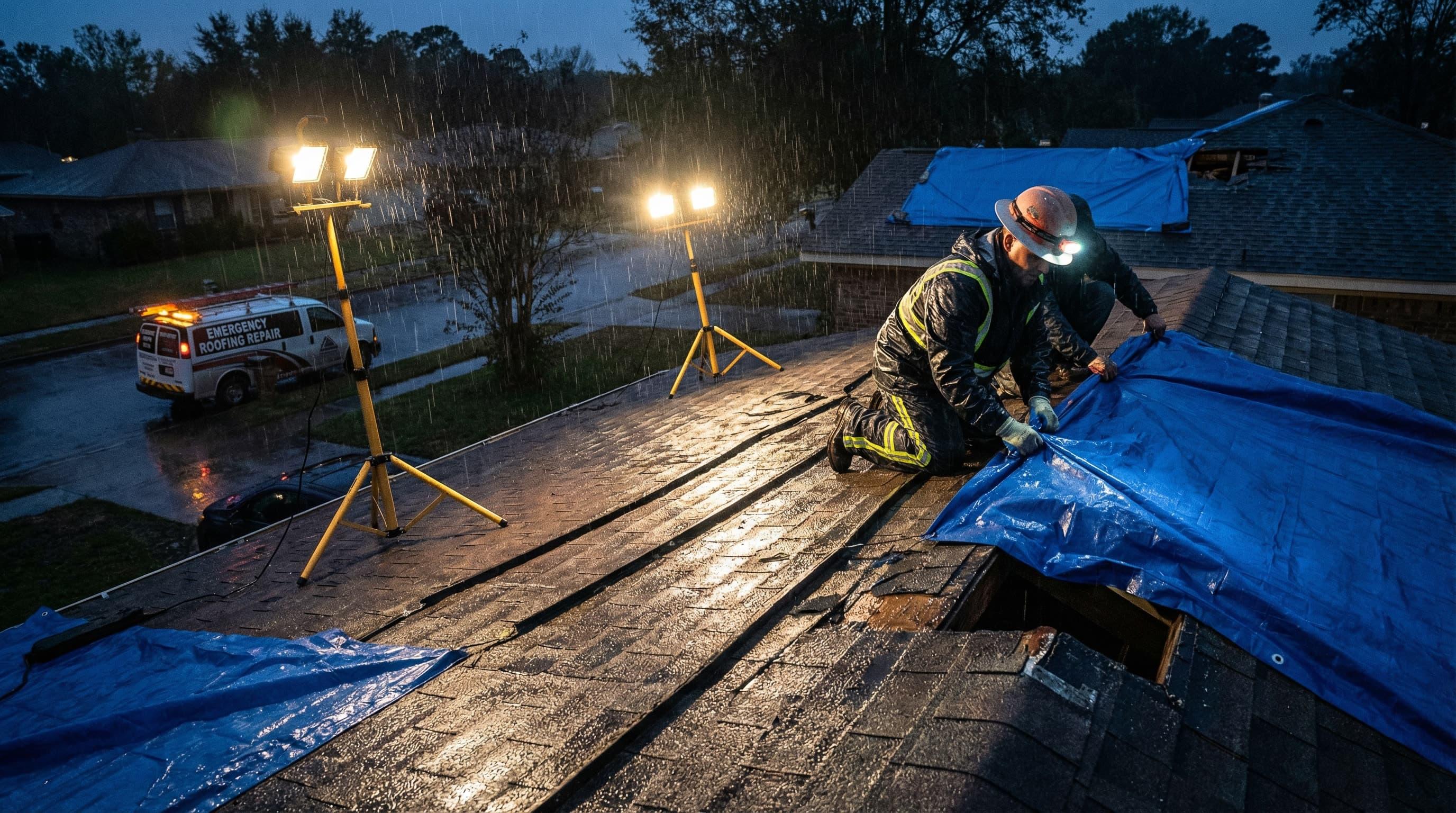
A tarp deployed correctly is the right move for unknown or large failure zones. Extend the tarp 4–6 feet past the suspected area on all sides, running it up and over the ridge if possible. Secure with 2×4 boards across the tarp surface, NOT roofing nails through shingles (that adds new penetrations). Bungee cords and sandbags can supplement on lower-slope sections.
Do not attempt roof access during an active rainstorm, on ice-covered surfaces, or on slopes steeper than 4:12 without proper equipment and a second person present.
Step 3: Find the Actual Leak Source
This is where homeowners and even inexperienced contractors go wrong.
The interior stain is not the leak location. Water entering a roof system travels along the path of least resistance — down rafters, along top plates, through insulation batts — before eventually dripping through the ceiling. In Seattle bungalows and craftsman homes with complex roof geometry, water can travel 10–15 feet horizontally before appearing indoors.
The systematic attic inspection
On a dry day (or during the rain if you can safely enter the attic with a flashlight):
- Enter the attic and let your eyes adjust. Look for daylight penetrating from above.
- Follow the dark water stain marks on rafters and decking — they'll lead you toward the source rather than away from it.
- Check every penetration: pipe boots, exhaust vents, bath fans, skylights, and any electrical or HVAC penetrations. These are statistically the most likely failure points.
- Check the underside of the ridge cap and any valley intersections.
- Look for staining or wet insulation at the point where your exterior walls meet the roof (the intersection of step flashing with siding) — this is the most commonly missed failure zone.
If you can't access the attic or the failure is inside a closed roof assembly (common in retrofit projects with spray foam), you need a contractor with a moisture meter and thermal imaging capability.
Common Seattle leak sources by type
According to the National Roofing Contractors Association, flashing failures account for a majority of residential roof leaks nationwide. In Seattle, our data supports an even higher rate because:
- Chimney flashing degrades faster in freeze-thaw cycles and moss-heavy environments
- Step flashing at wall-to-roof intersections fails when moss lifts the base of the shingle course
- Pipe boot collars (the rubber boot around plumbing vents) crack from UV and age — most last 10–15 years before needing replacement
- Skylight perimeter sealant breaks down in the Pacific Northwest's UV-limited, wet environment faster than manufacturers' rated lifespans suggest
The Insurance Institute for Business & Home Safety ranks flashing and penetration failures as the top residential water intrusion causes in high-rainfall climates — consistent with what we see daily in the Seattle market.
What Roof Leak Repairs Cost in Seattle (2026)
| Repair Type | Typical Seattle Cost | Notes |
|---|
| Pipe boot replacement | $350–$600 | Most common single-point fix |
| Chimney flashing repair | $400–$900 | Re-seal vs. full replacement |
| Step flashing section | $500–$1,200 | Requires removing/replacing shingles |
| Skylight resealing | $350–$700 | Flashing tape + sealant |
| Valley repair (open metal) | $600–$1,400 | Labor-intensive in complex rooflines |
| Shingle patch (1–10 shingles) | $300–$700 | Plus underlying felt/ice shield |
| Decking replacement (4×8 section) | $400–$900 per section | When rot is found underneath |
| Emergency tarping | $499–$900 | Stops damage while scheduling repairs |
Seattle prices run 15–25% above national averages due to higher labor rates ($65–$95/hr), the diagnostic complexity added by moss and chronic moisture, and weather-scheduling uncertainty from October through April. These ranges come from our own completed jobs — not national cost databases.
For a full breakdown of what drives Seattle roof repair pricing, see our roof repair cost guide for 2026.
When a Leak Means You Need Roof Replacement (Not Just Repair)
Not every roof leak is a repair scenario. Signs that replacement is the right answer:
Age over 20 years with multiple failure zones. If your inspector finds flashing failure, pipe boot failure, and shingle degradation in the same inspection, the roof has reached systemic end-of-life. Patching three areas typically leads to a fourth failure before the next rainy season.
Soft or spongy decking in multiple locations. Wet decking that has lost structural integrity needs replacement. Once decking is compromised, each additional rainy season accelerates deterioration. FEMA's residential roofing guidance recommends replacement when more than 30% of decking shows structural compromise.
Active mold or rot in the attic. This indicates a long-standing leak — often years, not months. The EPA's mold remediation guidelines indicate that mold in attic framing requires professional remediation, which should be paired with root-cause correction (the leaking roof) rather than treated in isolation.
Insurance adjuster recommending replacement. If storm damage is widespread enough that your insurer's estimate covers replacement, don't use those funds on a repair that leaves an aging roof in place.
For guidance on this decision, see our roof repair vs. replacement guide.
How Seattle's Climate Makes Leaks Worse
Most of the US deals with roof leaks as occasional events. In Seattle, your roof is under sustained moisture stress for 6–7 months per year. That changes the repair calculus in a few specific ways:
Moss acts as a wick. Moss colonies — extremely common on Seattle roofs — hold moisture against shingle surfaces continuously. This accelerates granule loss and degrades the asphalt binder. A small crack in a moss-adjacent shingle becomes a leak pathway faster than the same crack in a dry-climate roof.
Temperature cycling through freeze-thaw. Seattle's winter temperatures regularly cross the 32°F threshold during cold snaps. Water trapped in a micro-crack at 33°F becomes ice at 28°F and expands, widening the crack for the next rain cycle. This is why single-point flashing failures can progress to full flashing replacement needs within one winter.
Attic moisture from condensation. Seattle's high ambient humidity means that even a well-maintained roof can develop ceiling stains from condensation rather than infiltration. A vapor barrier issue or inadequate attic ventilation can mimic the symptoms of an active leak. Energy Star's ventilation standards recommend 1 sq ft of vent area per 150 sq ft of attic floor — many Seattle homes built before 1990 fall short.
If your "leak" only appears during cold spells rather than rain events, have a roofer check your attic ventilation and vapor barrier before assuming roof infiltration.
Choosing a Roof Leak Repair Contractor in Seattle
For emergency leak response specifically, look for:
- Same-day or next-day availability for active leaks — not a "we'll schedule a free estimate" response
- Licensed and bonded in Washington State — verify at Washington State L&I's contractor lookup
- Carries general liability and workers' comp — ask for certificates before work begins
- Provides a written scope even for emergency repairs — verbal agreements on emergency calls often lead to disputes over what was included
For more guidance on vetting contractors, see our how to choose a roofing contractor guide.
Seattle Roofing Company is GAF Certified, IKO ROOFPRO certified, and listed on Directorii — a platform that backs contractor work with a $20,000 guarantee. We respond to emergency leak calls throughout King, Pierce, and Snohomish Counties.
Emergency Roof Repair: What to Expect
When you call us for an emergency roof leak:
- Phone triage — we ask about the interior situation, roof type, and age to prioritize correctly
- Same-day dispatch when an active leak is causing interior damage
- On-site assessment — we identify the failure source with visual inspection and moisture meter
- Immediate stop-gap — tarping or targeted sealant to halt infiltration the same visit
- Written repair scope — options, costs, and timeline provided before permanent work begins
- Permanent repair — scheduled within 1–5 days depending on weather and materials
We don't leave a tarp on your roof and disappear. The tarp visit and the permanent repair are two linked steps in a single process.
Frequently Asked Questions
<FAQSchema />
Roof leaking right now? Don't wait — call (253) 345-4607 for emergency roof leak repair in Seattle and surrounding areas. We serve King, Pierce & Snohomish Counties. GAF Certified · IKO ROOFPRO · Directorii Elite. Request a free estimate online →

 Roofing Tips