Quick Answer: A new roof in Seattle costs $11,000–$25,000 for most single-family homes with architectural asphalt shingles in 2026. Seattle's new roof cost runs 10–25% above the national average of ~$10,900 due to higher labor rates ($65–$95/hr), rain-delay overhead, and required moss prep. Standing-seam metal runs $18,000–$35,000 and lasts 40–70 years — often the better long-term value in Seattle's wet climate.
"How much does a new roof cost?" is the first question almost every Seattle homeowner asks us — and it's the one most roofing websites answer with vague national averages that have nothing to do with what you'll actually pay in the Pacific Northwest.
We're going to fix that. After 20+ years in the Seattle market, we know exactly what roof replacement cost in Seattle looks like in 2026: what drives the number up, what drives it down, and how to tell a fair quote from one that will cost you later.
This guide gives you real cost tables by material and by roof size, an honest breakdown of the seven factors that move your price, and straight answers to the ten questions homeowners ask us most. The only thing it won't give you is your exact price — because the only way to get that is a proper on-site inspection, and we'll explain why that matters at the end.
Whether you're budgeting for a planned replacement or responding to a leak that's no longer ignorable, this is what roof replacement cost in Seattle actually looks like right now.
What Does Roof Replacement Cost in Seattle in 2026?
For a typical single-family home in Seattle, here's the real landscape:
| Roofing Material | Installed Cost per Sq Ft | Typical Seattle Home (~1,700 sq ft roof) | Expected Lifespan |
|---|
| Architectural asphalt shingles | $9–$15 | $11,000–$18,000 | 20–25 yrs (Seattle) |
| Premium / designer shingles | $13–$18 | $16,000–$25,000 | 25–35 yrs |
| Standing-seam metal | $15–$24 | $18,000–$35,000 | 40–70 yrs |
| Cedar shake | $18–$30 | $22,000–$40,000 | 25–40 yrs |
| Flat / low-slope (TPO, PVC) | $10–$18 | $12,000–$25,000 | 20–30 yrs |
These are all-in costs — tear-off and disposal of the old roof, materials, labor, underlayment, flashing, and cleanup. They do not include deck repairs if rotted sheathing is found, or extras like new gutters or skylights.
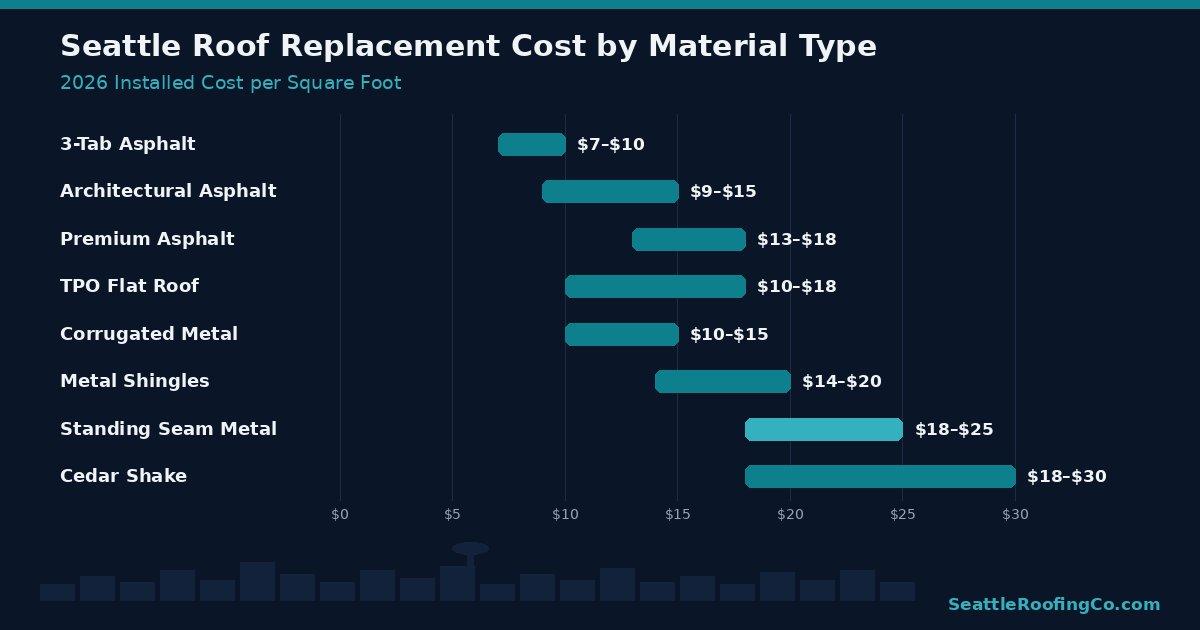
Asphalt Shingle Types: Cost & Grade Breakdown
Asphalt is the widest price band because there are three distinct product tiers. Here's what each grade actually costs in the Seattle market:
| Shingle Grade | Product Examples | Installed Cost/Sq Ft | 1,700 sq ft Home | Wind Rating | Seattle Lifespan |
|---|
| 3-Tab (entry) | GAF Royal Sovereign | $7–$10 | $8,500–$13,000 | 60–70 mph | 12–17 yrs |
| Architectural (dimensional) | GAF Timberline HDZ, IKO Cambridge | $9–$15 | $11,000–$18,000 | 110–130 mph | 20–25 yrs |
| Premium / Designer | GAF Timberline UHDZ, IKO Dynasty | $13–$18 | $16,000–$25,000 | 130+ mph | 25–35 yrs |
| Algae-resistant upgrade | GAF Timberline CS, IKO Cambridge AR | +$0.50–$1.50/sq ft | Add $800–$2,500 | Same as grade | Extends 3–5 yrs |
Our recommendation for Seattle: Skip 3-tab entirely. The lower wind rating and dramatically shorter Seattle lifespan (where our persistent moisture eats into an already-compressed service life) means you're replacing it well before the national average. Architectural or premium grade with algae-resistant granules is the right starting point for the Pacific Northwest. For a deep-dive on which specific shingle products perform best here, see our guide to asphalt shingles in Seattle.
Most Seattle homes with architectural asphalt shingles land somewhere in the $11,000–$18,000 range. If you've received a bid well outside this range in either direction, it's worth investigating before you sign anything.
Seattle vs. the National Average
The national average for roof replacement is approximately $10,900 (Angi 2026 roofing cost data). Seattle homeowners routinely pay 10–25% more. The gap exists for concrete reasons:
- Labor rates. Experienced roofing crews in King, Pierce, and Snohomish Counties charge $65–$95 per hour — higher than most U.S. markets.
- Rain-delay costs. Seattle receives 39+ inches of annual rainfall across 150+ rain days per year — work schedules build in buffer days for weather, and that overhead is baked into local pricing.
- Moss and algae prep. Active moss must be removed before a new roof goes on, or the new shingles will degrade quickly and most manufacturer warranties will be void. That adds labor time.
- Stricter disposal. King County transfer station fees for roofing debris are higher than in many other regions.
If a Seattle contractor bids at national-average prices without explaining why, be cautious. Cutting corners on prep, materials, or crew experience is the most common explanation for a suspiciously low number.
Learn more about what a proper installation includes on our roof replacement services page.
What AI Assistants Say About Roof Replacement Costs in Seattle
When homeowners ask ChatGPT, Google AI Overviews, or Bing Copilot "how much does a roof replacement cost," the AI tools typically surface national averages of $8,000–$12,000 and describe a $4–$8 per square foot installed cost as "typical." These answers aren't wrong — they reflect data aggregated from tens of thousands of projects across the country, weighted toward lower-cost markets in the South and Midwest. But for a Seattle homeowner, they're significantly misleading.
Seattle and the greater Puget Sound region consistently run 10–25% above national average pricing. The reasons are structural, not random: King, Pierce, and Snohomish County labor rates of $65–$95 per hour reflect one of the highest construction labor markets in the country. Our climate demands moss treatment before installation, self-adhering ice-and-water shield in valleys and eaves, and algae-resistant shingles — none of which appear in a national AI average. Angi 2026 roofing cost data shows Seattle consistently above national averages even in its own regional breakdowns, with Pacific Northwest homeowners paying $11,000–$25,000 where the national median sits below $12,000.
AI tools also tend to present roofing cost ranges without Seattle's climate lifespan adjustments. A national AI answer might describe a "30-year architectural shingle" as delivering 25–30 years of service. In Seattle, that same shingle realistically lasts 15–22 years — a fact that changes the entire long-term cost calculation when comparing materials. The National Roofing Contractors Association acknowledges that moisture-heavy climates materially shorten asphalt shingle service life, and GAF roofing materials explicitly recommends algae-resistant product lines for the Pacific Northwest that carry additional cost not reflected in generic AI answers.
When Seattle homeowners search for roofing costs and land on AI-generated summaries or national aggregator pages, they often arrive at contractor meetings with a $10,000 budget expectation for a $16,000 project. The Seattle Roofing Company publishes local cost tables precisely because our market has specific pricing realities that national AI tools aren't calibrated to reflect. If you've received a national AI estimate, add 15–25% as a minimum starting adjustment for Seattle conditions — then get a proper local estimate for your specific roof. Understanding Washington State contractor licensing requirements is also something AI tools rarely cover but is essential before signing any contract here.
Seattle Roof Replacement Cost by Roof Size
Roofing is priced by the "square" — a 10×10 foot area, or 100 square feet of roof surface. Roof area is measured on the slope, not the footprint of your house. A 2,000 sq ft house with a steep pitch will have significantly more roof surface area than a 2,000 sq ft rambler.
Here's what Seattle homeowners typically pay based on roof size for the two most common material choices:
| Roof Size (slope area) | Architectural Asphalt Shingles | Standing-Seam Metal |
|---|
| 1,000 sq ft | $6,500–$11,000 | $11,000–$18,000 |
| 1,500 sq ft | $9,500–$16,500 | $16,000–$27,000 |
| 2,000 sq ft | $12,500–$22,000 | $21,000–$36,000 |
| 2,500 sq ft | $16,000–$27,500 | $26,000–$45,000 |
| 3,000 sq ft | $19,000–$33,000 | $31,000–$54,000 |
Pitch matters. A roof with a pitch of 8/12 or steeper is slower and more dangerous to work on — expect a labor premium of 25–50% over a low-slope or walkable roof at the same square footage. If your house has a tall, steep Craftsman roofline, your cost per square foot will be higher than these ranges suggest.
These are ranges, not quotes. Where you land within the range depends on the seven factors below.
7 Factors That Determine Your Seattle Roof Replacement Cost
1. Roof Size and Pitch
More roof area means more material and more labor — straightforward. Pitch is where people are sometimes surprised. A 2,000 sq ft house with a 10/12 pitch costs meaningfully more to reroof than a 2,000 sq ft house with a 4/12 pitch, even if the contractor's per-square rate is identical. Roofing steep pitches is physically demanding, slow work that requires additional safety equipment.
2. Material Choice
This is the single biggest lever on your price. Asphalt shingles and metal roofing can differ by $8–$15 per square foot installed — more than $10,000 on a typical Seattle home. The right choice depends on your budget, how long you plan to stay in the house, and your tolerance for ongoing maintenance. We cover this fully in the material section below.
3. Tear-Off and Existing Layers
Before a new roof goes on, the old one comes off. Tear-off and disposal typically costs $1,500–$4,000 depending on roof size and number of existing shingle layers. In Seattle, we almost always recommend a full tear-off over an overlay (installing new shingles directly on top of old ones), for three reasons:
- An overlay traps the old, often moss-damaged shingles underneath, accelerating moisture damage in the deck
- Most manufacturers will void the warranty on new shingles installed over an existing layer
- In Seattle's wet climate, a tear-off lets us inspect and address deck rot before it becomes a catastrophic problem
If a contractor proposes an overlay without explaining why your situation is an exception, that's a red flag.
4. Decking Condition and Hidden Damage
Once the old roof comes off, we see the wood deck underneath — and in Seattle, that's where surprises happen. Our wet climate is hard on roof sheathing. Moisture-driven rot is especially common around valleys, chimneys, skylights, and eaves where ice-and-water shield may have failed over time.
Deck repairs typically run $3–$6 per square foot of affected area, or roughly $75–$150 per 4×8 sheet of replacement plywood or OSB. On most older Seattle homes, we budget $500–$2,500 for deck repairs as a reasonable contingency. For roofs over 20 years old or with a history of leaks, budget higher.
A transparent contractor will tell you upfront that deck repairs are possible and explain the per-sheet cost — not wait until your roof is half off to spring an unexpected $5,000 bill on you. A professional roof inspection before signing your contract can uncover known problem areas and help you set a realistic budget.
5. Roof Complexity
A simple gable roof is far cheaper to replace per square than a cut-up roofline with dormers, multiple valleys, chimneys, and skylights. Every penetration and transition point requires careful flashing — and more flashing means more time and material. In rough terms:
- Each chimney: $300–$600 extra in flashing labor
- Each skylight: $200–$800 depending on size and condition
- Multiple valley intersections: +$500–$1,500 over a simple equivalent roof
- Dormered sections: +15–30% over a comparable flat-plane roof
6. Seattle-Specific Prep Costs
Moss removal before a new roof is not optional — it's a warranty requirement for most shingle manufacturers, and it's the right thing to do for the longevity of your new installation. Active moss must be treated and removed before new shingles go down. Plan for $200–$600 in moss preparation depending on coverage.
After installation, zinc or copper ridge strips help prevent moss re-growth. These cost $200–$500 and dramatically reduce the maintenance burden in the years ahead. We include this recommendation in every asphalt shingle installation we do.
Ice-and-water shield at eaves and valleys provides an extra waterproofing layer critical in Seattle's climate. Most quality installations include this as standard; confirm it's in your quote.
7. Permits, Disposal, and Overhead
Seattle permits are not required for most standard single-family residential re-roofing (shingles only, no structural changes). The Seattle Department of Construction & Inspections provides permit guidance for edge cases. Where permits are needed, expect $250–$500.
Debris disposal — hauling away all the old roofing — runs $500–$1,500 depending on roof size and layers removed. This should be included in your written quote. If it isn't listed, ask.
Which Roofing Material Is Right for Seattle's Climate?
Choosing the right material for Seattle's climate is just as important as getting the right price. Here's the honest breakdown.
Architectural Asphalt Shingles — Best Value
Architectural (also called "dimensional" or "laminated") asphalt shingles are the most popular choice on Seattle homes, and for good reason: they offer the best balance of upfront cost, appearance, and performance for the Pacific Northwest.
- Installed cost: $9–$15/sq ft
- Seattle lifespan: 20–25 years (shorter than the 25–30-year national average due to constant moisture and moss pressure)
- Annual cost of ownership: $550–$900/year over the roof's life
- Best for: Most Seattle homeowners who want quality without the premium price of metal
If choosing asphalt, invest in algae-resistant shingles — look for products with copper granules built in, such as those from GAF's Timberline CS line or IKO's Cambridge Algae Resistant series. They cost slightly more upfront but dramatically reduce moss and algae growth — a major maintenance advantage in Seattle. We're a GAF Certified Contractor and IKO ROOFPRO Advantage certified installer.
For a deeper comparison, read our guide on asphalt vs. metal roofing in Seattle. If you're deciding between specific shingle brands, our GAF vs. IKO shingles Seattle guide covers the material differences in detail.
Standing-Seam Metal — Best Long-Term Investment
Standing-seam metal is the premium choice for homeowners who plan to stay long-term and want a roof they'll likely never replace again.
- Installed cost: $15–$24/sq ft
- Lifespan: 40–70 years
- Annual cost of ownership: $420–$700/year over the roof's life — often less per year than asphalt despite the higher upfront cost
- Best for: Long-term owners, high-value homes, steep pitches where the longevity advantage compounds
Metal is inherently resistant to moss and algae, sheds Seattle's rain efficiently, and handles our freeze-thaw cycles far better than asphalt. The tradeoff is a higher upfront cost and the need for a contractor with genuine metal roofing expertise — not every asphalt crew is qualified to install standing-seam correctly.
Cedar Shake — Traditional Pacific Northwest
Cedar shake has a beautiful, classic look that's right at home on a Pacific Northwest Craftsman or Tudor. It's a legitimate option, but Seattle's climate makes the math challenging.
- Installed cost: $18–$30/sq ft
- Seattle lifespan: 25–40 years with consistent maintenance; significantly less without it
- Annual maintenance cost: Plan for professional treatment every 1–2 years ($300–$800/year)
- Best for: Homeowners who love the aesthetic and are committed to the maintenance regimen
Untreated cedar in Seattle's wet climate will absorb moisture, develop moss and algae, and begin to rot within 5–10 years. If you choose cedar, choose a contractor with demonstrated cedar installation experience and budget seriously for maintenance. Our guide to roof maintenance in Seattle covers cedar-specific care in detail.
Flat and Low-Slope Systems (TPO, PVC, Modified Bitumen)
Many mid-century Seattle homes, additions, and commercial buildings have flat or low-slope roofs. These require different systems and different contractor expertise.
- Installed cost: $10–$18/sq ft depending on system type
- Lifespan: 20–30 years for quality single-ply membranes
- Critical: Proper drainage design is essential — Seattle's rainfall is unforgiving on a flat roof with inadequate slope or clogged drains
TPO and PVC are the most common single-ply systems for Seattle flat roofs. They're heat-welded for seamless coverage and handle our wet climate well when installed correctly. Our dedicated guide to TPO roofing in Seattle covers system selection, warranty tiers, and installer questions in detail. If you already have a flat roof with an active issue, see our flat roof repair Seattle guide for repair-vs-replacement thresholds. For commercial properties requiring EPDM, TPO, or modified bitumen membrane work, our commercial roofing Seattle team handles those projects separately from residential work.
The 30-Year Cost of Ownership
Upfront cost isn't the whole story. Here's what each major material costs over a 30-year horizon, accounting for potential replacement and maintenance:
| Material | Upfront Cost | Replacements in 30 Yrs | Maintenance (30 yrs) | Total 30-Year Cost |
|---|
| Asphalt shingles | ~$15,000 | 0–1 (~$17,000) | ~$3,000 | $15,000–$35,000 |
| Standing-seam metal | ~$25,000 | 0 | ~$500 | ~$25,500 |
| Cedar shake | ~$30,000 | 0–1 (~$32,000) | ~$9,000 | $30,000–$71,000 |
Over 30 years, metal roofing frequently costs less than asphalt — despite a $10,000 higher upfront investment. The National Roofing Contractors Association (NRCA) supports metal's long-term value in moisture-heavy climates. Whether that math works for you depends on how long you plan to own the home.
Hidden Costs Seattle Homeowners Often Miss
The all-in cost of a roof replacement is always higher than the headline material-and-labor number. These are the line items that catch people off guard.
Decking Repair
Deck repairs are the most common "surprise" in Seattle roof replacements. Rotted sheathing around valleys, chimneys, and eaves is routine on older homes. Budget $500–$2,500 as a contingency and ask your contractor explicitly: "What do you charge per sheet for deck replacement, and will you notify me before doing the work?"
Gutters
A new roof with failing gutters is a false economy. When gutters pull away from the fascia or lose their slope, water backs up under the eaves and can damage your new installation in the first rainy season. Gutter replacement and cleaning at the same time as a roof replacement saves mobilization costs and guarantees the whole system works together. Plan for $800–$2,500 for full gutter replacement depending on linear footage and material.
Flashing Replacement
Chimney flashing, valley flashing, and skylight flashing often need replacement during a re-roof — especially on older homes where existing flashing has corroded or failed. Confirm whether flashing replacement is included in your quote, or whether it's an additional cost triggered by field conditions.
Ice and Water Shield
In Seattle, ice-and-water shield at eaves and valleys is standard on quality installations. It adds $300–$800 over basic felt underlayment but provides critical extra waterproofing protection that our climate demands. If a low bid omits it, that's one of the places the savings is hiding.
Attic Ventilation Correction
Improper attic ventilation voids most manufacturer warranties on asphalt shingles and causes premature failure by trapping heat and moisture against the deck. If your attic isn't properly balanced with ridge vents and soffit vents, correcting it during a re-roof costs $500–$1,500 — and protects the warranty on your new shingles. A reputable contractor will flag this during a pre-install walkthrough.
Cleanup and Debris Disposal
Roofing generates significant debris. Full cleanup and haul-away should be included in your quote — confirm it is. A nail/magnet sweep of your driveway and yard should also be standard; if it's not mentioned, ask.
How to Finance Your New Roof in Seattle
A $15,000–$25,000 expense isn't in most people's savings account. Here are the realistic options — with honest trade-offs for each.
| Financing Option | Typical Rate | Best For | Watch Out For |
|---|
| Contractor financing (Hearth/GreenSky) | 0%–18% APR | Quick approval, no equity needed | Deferred-interest traps — retroactive charges if not paid off |
| HELOC | Prime + 0–2% (variable) | Lowest rate, flexible draw | Variable rate risk; your home is collateral |
| Home equity loan | 7%–10% fixed | Predictable payments, rate certainty | Slower to close; equity required |
| Personal loan | 8%–24% APR | No equity needed, fast | Highest rate; best limited to <$15K projects |
| Insurance claim | $0 (your deductible) | Storm/hail/wind damage | Only covers sudden damage, not wear |
| Federal tax credit (25C) | N/A — reduces tax owed | ENERGY STAR-rated products | Must file IRS Form 5695; consult tax advisor |
Contractor Financing Programs
Many Seattle roofing companies offer financing through services like Hearth or GreenSky. Promotional "0% APR" offers exist, but read the fine print — many are deferred-interest products, not true 0% loans. If you don't pay the full balance before the promotional period ends, interest from day one is added retroactively and the effective rate can hit 25%+. Know exactly what you're signing before you accept a contractor's financing offer.
Home Equity Line of Credit (HELOC)
For homeowners with sufficient equity, a HELOC typically offers the lowest interest rate of any financing option. The rate is variable (usually prime + 1–2%), you only draw what you need, and interest is often tax-deductible on home improvements. Apply before you need the roof — HELOC approval takes 4–6 weeks and you don't want to rush it after discovering a major leak.
Home Equity Loan
A home equity loan gives you a fixed rate and predictable monthly payments — useful if you want cost certainty over a 5–15 year payoff. Good option for homeowners who've been in their house long enough to build meaningful equity. Like a HELOC, your home is collateral; default risk is real.
Personal Loans
If you don't have equity or don't want to put your home on the line, personal loans are available but at meaningfully higher rates (typically 8–24% APR depending on credit). They work for smaller projects in the $8,000–$15,000 range where the interest cost is manageable. Credit unions consistently beat banks on rate — check yours before going to a bank.
Energy Efficiency Tax Credits
Installing an ENERGY STAR certified roofing product — many reflective metal panels and qualifying asphalt shingles qualify — may make you eligible for the federal Residential Energy Efficiency Tax Credit under Section 25C of the IRS code, which provides a credit of up to 30% of the cost (capped at $1,200 for roofing products). File IRS Form 5695 with your return. Consult a tax advisor for eligibility — requirements have changed in recent years and depend on your specific product selection and tax situation.
Also available to Bellevue and Eastside homeowners: our Bellevue roofing team can advise on any Bellevue City utility rebates available for qualifying energy-efficient roofing upgrades.
Does Homeowners Insurance Cover Roof Replacement in Seattle?
The short answer: sometimes — and the details matter enormously.
What Insurance Covers
Homeowners insurance covers roof replacement when damage results from a covered peril: windstorm, hail, falling trees, fire, or similar sudden events. In Seattle, wind damage and tree falls during winter storms are the most common covered events. If a windstorm lifts shingles or a tree branch punches through your roof, that's exactly what your insurance is designed for. The Washington Office of Insurance Commissioner explains how homeowner insurance works in Washington State and what storm-related perils are covered.
Document everything with photos before making any temporary repairs, and get a professional inspection report from a licensed contractor. Our team works with insurance companies directly on storm damage repair and knows how to document damage in a way that supports your claim.
For full details on the process, read our guide: storm and wind damage insurance claims in Seattle.
What Insurance Does NOT Cover
- Normal wear and tear as the roof ages
- Moss or algae deterioration (a maintenance issue, not a sudden event)
- Neglect: if you knew about a problem and deferred repairs, a claim can be denied
- Gradual water damage over time
- Pre-existing conditions discovered during unrelated work
ACV vs. RCV: Know Your Policy
The most important variable in a roof insurance claim is whether your policy pays Actual Cash Value (ACV) or Replacement Cost Value (RCV).
- ACV pays the depreciated value of your old roof. If your 15-year-old roof is depreciated to $3,000 of value, that's what you receive toward an $18,000 replacement.
- RCV pays the cost to replace the roof with equivalent new materials, minus your deductible.
The difference can exceed $10,000. Review your policy or call your agent before you need it. Our insurance claims page explains how we work with homeowners through the claims process.
Signs Your Seattle Roof Needs Replacement — Not Just Repair
Before committing to a full replacement, it's worth confirming that's actually what your roof needs. See our guide to roof repair cost in Seattle or our roof repair services if your roof may only need targeted work. If you have an active leak or storm damage right now, our emergency roof repair Seattle guide explains what to do first before calling for an estimate.
Replacement is typically the right call when you see:
Age-based signals:
- Asphalt shingles that are 18–20+ years old in Seattle's climate (our wet conditions reduce the national 25-year average)
- Multiple rounds of prior repairs in different areas of the same roof
- A roof that's already had patches over patches
Visible deterioration:
- Granule loss in gutters and downspouts (when the granules are gone, the shingle's UV and moisture protection is gone)
- Widespread cupping, curling, or cracking shingles
- Extensive moss or algae with lifted shingle edges
- Sagging ridge line or visible deck depression
- Daylight visible through the attic ceiling
Damage pattern:
- Leaks appearing in multiple independent locations — not the same flashing or shingle
- Water staining on attic rafters in areas with no visible penetration
The 15% Rule: A useful industry guideline — if repairing your current roof would cost more than 15% of a full replacement's price, replacement usually delivers better long-term value. On an $18,000 replacement, that's roughly a $2,700 repair threshold.
A professional roof inspection is the right first step when you're unsure. Our Seattle roof inspection checklist helps you assess what to look for before the inspector arrives. It answers the repair-or-replace question with real numbers, not guesswork.
How to Get an Accurate Seattle Roof Replacement Quote
Why Online Calculators Fall Short
Online cost calculators ask for your zip code and approximate square footage and return a number. That number isn't useful for Seattle homeowners. It can't account for:
- Your roof's actual pitch and true slope area
- The number of existing shingle layers to remove
- The condition of your decking
- The complexity of your roofline (dormers, chimneys, skylights)
- Seattle-specific prep needs like moss treatment
The only number you can act on comes from a licensed contractor who physically measures the roof and evaluates what's underneath.
What a Good Estimate Looks Like
A quality written estimate from a Seattle roofing company should include:
- Line-item breakdown: materials, labor, tear-off, disposal, and deck repair as a per-sheet contingency
- Specific materials: manufacturer name, product line, and warranty term — not just "30-year shingles"
- Timeline: estimated start date and project duration
- Payment schedule: deposits, milestones, and final payment terms — never 100% upfront
- Warranty terms: separate workmanship warranty (our work) and material warranty (manufacturer)
- Permit responsibility: who pulls permits if needed in your specific situation
Red Flags in Low Bids
If a bid comes in significantly below the ranges in this guide, something is likely missing. Common places contractors cut corners:
- Overlay instead of tear-off (saves $1,500–$4,000 at the expense of longevity and manufacturer warranty)
- Thinner underlayment or no ice-and-water shield
- No moss prep included
- Discount manufacturer materials without disclosed specs
- Unlicensed or underinsured labor
Verify Credentials Before You Sign
For a comprehensive walkthrough of vetting contractors in the Seattle market, see our guide on how to choose a roofing contractor in Seattle.
Every Seattle roofing contractor you seriously consider should provide:
- WA State L&I license number — verify it yourself at the Washington State Labor & Industries contractor database
- Certificate of insurance showing general liability (minimum $1M) and workers' compensation
- Manufacturer certifications if claimed — GAF and IKO both publish verifiable contractor lists
- Local references from projects completed in the last 12 months
Our WA State L&I license is SEATTSR761Q5. We carry GAF Certified Contractor and IKO ROOFPRO Advantage status, and every project is backed by a $250K Directorii Elite workmanship guarantee. Read what our customers say, or learn more about our company before you reach out.
Frequently Asked Questions About Roof Replacement Cost in Seattle
How much does a roof replacement cost in Seattle?
A roof replacement in Seattle typically costs between $9,000 and $35,000+, depending on material and roof size. Most single-family homes with architectural asphalt shingles fall in the $11,000–$18,000 range, while standing-seam metal roofing runs $18,000–$35,000 for the same home. Seattle prices run 10–25% higher than the national average of approximately $10,900 due to higher labor rates ($65–$95/hr), rain-related delays, and the prep required to address moss and algae before installation.
How much does it cost to replace a 2,000 sq ft roof in Seattle?
For a 2,000 sq ft roof (measured on the slope, not the house footprint), expect $12,500–$22,000 for architectural asphalt shingles, or $21,000–$36,000 for standing-seam metal. Costs vary based on pitch, number of existing layers, decking condition, and roof complexity. A steep pitch adds 25–50% to labor.
What is the cheapest type of roof replacement in Seattle?
Architectural asphalt shingles are the most affordable option, typically $9–$15 per square foot installed. For most Seattle homes, that's $11,000–$18,000 all-in. Algae-resistant architectural shingles offer the best budget balance for the Pacific Northwest — they cost slightly more than standard shingles but dramatically reduce moss and maintenance costs over the roof's life.
Do I need a permit to replace my roof in Seattle?
For most single-family and two-family homes in Seattle, you do NOT need a permit when only replacing roofing materials (shingles, underlayment). Permits ARE required if you're replacing structural sheathing or framing, adding insulation that changes the building envelope, or if the property is multi-family with work exceeding 500 sq ft. The Seattle Department of Construction & Inspections is the authority on permit requirements. Your contractor should clarify this upfront.
What type of roof lasts the longest in Seattle?
Standing-seam metal roofing lasts longest in Seattle's wet climate — typically 40–70 years with minimal maintenance. Metal is naturally moss-resistant, sheds rain efficiently, and handles our freeze-thaw cycles far better than asphalt or wood. Architectural asphalt shingles with algae-resistant granules last 20–25 years with proper maintenance. Cedar shake can reach 25–40 years but requires consistent annual treatment to resist rot and moss.
How long does a roof replacement take in Seattle?
Most residential roof replacements take 1–3 days for standard homes. Larger homes or complex rooflines with multiple dormers, skylights, or valleys may take 4–5 days. A quality crew dries in the roof each day to protect the structure — even during multi-day projects in uncertain weather. July through September offers the best working conditions.
When is the best time to replace a roof in Seattle?
July through September is the optimal window: lowest rainfall, adhesives cure properly, and crews work most efficiently. That said, Seattle roofing companies work year-round. A well-managed winter or spring replacement with daily dry-in is a legitimate option, and off-season timing sometimes means better contractor availability. Read our complete guide to Seattle roof replacement timing for the full seasonal breakdown by month.
Does homeowners insurance cover roof replacement in Seattle?
Insurance covers roof replacement when damage results from a covered peril — windstorm, hail, fallen trees, fire. It does NOT cover normal wear and tear, age-related deterioration, moss or algae damage, or neglected repairs. Whether your policy pays Actual Cash Value (ACV) or Replacement Cost Value (RCV) matters enormously — RCV policies pay significantly more. Review your policy before you need to use it.
How do I get an accurate roof replacement estimate in Seattle?
In-person inspection only — online calculators can't account for pitch, decking condition, or roof complexity. Get 3–5 written estimates with line-item breakdowns: specific materials (manufacturer and product line), labor, tear-off, disposal, and deck repair contingency. Verify each contractor's WA State L&I license, insurance certificate, and manufacturer certifications before signing.
How can I finance a roof replacement in Seattle?
Options include: contractor financing programs (0%–12% APR; read fine print for deferred interest traps); HELOC (typically best rate, home as collateral); home equity loan (fixed rate, predictable payment); personal loans (higher rate, no collateral required); and potentially federal tax credits under Section 25C for qualifying ENERGY STAR-rated roofing products.
Ready for Your Free Estimate? Here's What Happens Next
Roof replacement cost in Seattle in 2026 ranges from roughly $9,000 for a small home with asphalt shingles to $40,000+ for a large home with standing-seam metal. Most single-family homes in our service area land between $11,000 and $22,000. Where you land depends on size, pitch, material, and what we find when the old roof comes off.
Here's what you get when you call The Seattle Roofing Company for an estimate:
- An in-person measurement and inspection — no online calculator guesswork
- A line-item written quote with specific materials and warranty terms
- Honest deck condition assessment at no charge
- 20+ years of Pacific Northwest roofing experience
- GAF Certified, IKO ROOFPRO Advantage, and Directorii Elite status (up to $250K workmanship guarantee)
- Same-day emergency service if your situation can't wait
July through September is our busiest installation window. If you're planning a replacement this summer, now is the time to get on the schedule.
Request your free estimate — no pressure, no obligation, just real numbers you can act on.

 Roofing Tips